Ok, I know I must be certifiably insane for taking it this far, but I just wanted to do this while its fresh in my mind and so that I have it documented for myself, and to visualize better what happens during say around 10ms.
check out the following diagram(available for limited time):
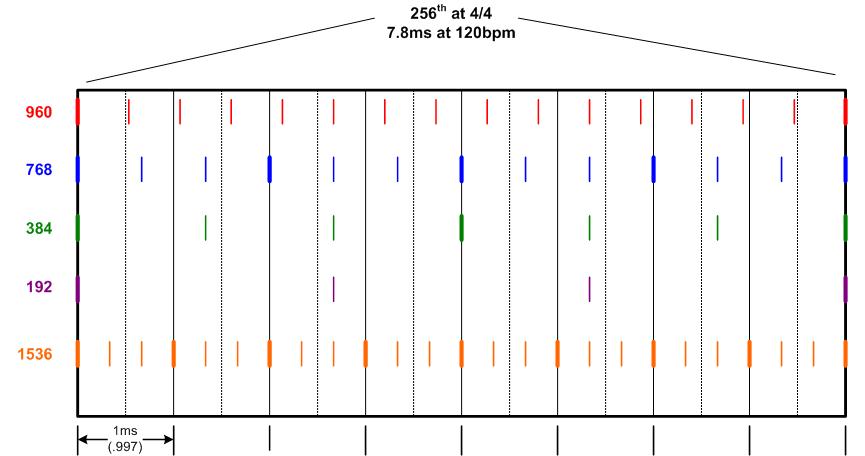
How to read this is that the big rectangle timeline represents one 256th note division of time, in 4/4 time at 120bpm, occurring over 7.8ms. The vertical lines in that big rectangle represent further metrical sub-divisions of a 256th note at 4/4, no triplets.
The tick marks along the bottom more or less show approximately 1ms of time. This value is not exact and depends on the tempo. Also the MM timer is not perfect. However, in Sonar, at some foggy interval of about 1ms, the MM timer goes off, obtains midi events from the hardware interface, assumes that they all happened at the end of that ~1ms time period and then assigns them to the closest
red notch, which is the 960ppqn grid.
Notice that within the time that it takes for one 256th division, not a single one of those 960 ticks lines up on a metrical division. Only the ones lining up exactly on perfectly quantized 256th notes.
Now observe 768, 384, 192 and 1536. Not only do they have a lot of ticks that line up exactly on metrical divisions, but the ones that don't line up are actually evenly spaced as thirds in between the ones that do line up.
I don't really know what to make of all this other than to just say "interesting" and wonder what the effect would be if I could actually change the real midi resolution to some of these others. We are really talking about sub millisecond precision here in terms of where the resulting notes end up on the track.
We are NOT talking about
capturing accurately. That is not possible no matter what. There is no way around the 1ms of midi slop due to the MM timer + whatever the DIN and USB is doing. However, when the notes finally do end up on the track, the question is, does it matter if they end up somewhat randomly scattered within a 10ms window, or will things sound tighter if the notes tend to gravitate towards metrical locations when they are stored?
Anyway, enough from me on this. Hope someone finds this interesting.