2009/10/21 13:23:54
stuhldreher
Before I start ripping things apart to try and record some LP's onto my hard drive:  Can I use a Mic preamp box to boost the signal enough from a turntable than record that in something like Sonar?
thanks...
2009/10/21 13:24:55
Beagle
you mean a mic pre like on a mixer?  yeah, that's good enough to bring it up to line level for your sound card.
2009/10/21 13:30:58
space_cowboy
No No No No No

THere is a huge difference. 

Records have an equalization curve applied before the grooves are cut.  You have to un-do that.  You need a RIAA thingy. 
2009/10/21 13:31:02
Moshkiae
Hi,

I had that problem ... 1500 LP's ... great stereo and speakers ... and no computer ...

Problem solved!

I sprung a leak and got me a M-Audio 1010LT ... and you can use two of those inputs for the turntable directly ... mind you it takes a bit getting used in that sound card, but it is a lot easier now ... put lp on, start audacity ... end of story ...

If you use anything else, specially externals, in general the quality slips and inevitably that hiss and deterioration when you add more items in between the source and the end ...

Well, now to start ripping 1500 albums, half of which will never be on LP!
2009/10/21 13:33:16
Beagle
space_cowboy


No No No No No

THere is a huge difference. 

Records have an equalization curve applied before the grooves are cut.  You have to un-do that.  You need a RIAA thingy. 
Bo - what do you mean?  can you elaborate please?
 
or are you trying to be "unfunny"?
2009/10/21 13:44:01
stuhldreher
Sorry, for not explaining what I want to do:
Will this flow work:
record player ---> M-aUDIO dmp3 mic Preamp box --- >Presonus fixbox audio interface ---> record with Sonar...
thanks


2009/10/21 13:51:28
space_cowboy


RIAA equalization From Wikipedia, the free encyclopedia Jump to: navigation, search
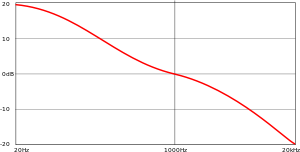
The RIAA equalization curve for playback of vinyl records.


RIAA equalization is a specification for the correct playback of gramophone records, established by the Recording Industry Association of America (RIAA). The purpose of the equalization is to permit greater playback times, improve sound quality, and to limit the vinyl damages that would otherwise arise from recording analog records without such equalization.
The RIAA equalization curve has operated as a de facto global industry standard for the recording and playback of vinyl records since 1954. Before then, especially from 1940, each record company applied its own equalization; there were over 100 combinations of turnover and rolloff frequencies in use, the main ones being Columbia-78, Decca-U.S., European (various), Victor-78 (various), Associated, BBC, NAB, Orthacoustic, World, Columbia LP, FFRR-78 and microgroove, and AES.


The RIAA curve

RIAA equalization is a form of preemphasis on recording, and deemphasis on playback. A record is cut with the low frequencies reduced and the high frequencies boosted, and on playback the opposite occurs. The result is a flat frequency response, but with noise such as hiss and clicks arising from the surface of the medium itself much attenuated. The other main benefit of the system is that low frequencies, which would otherwise cause the cutter to make large excursions when cutting a groove, are much reduced, so grooves are smaller and more can be fitted in a given surface area, yielding longer playback times. This also has the benefit of eliminating physical stresses on the playback stylus which might otherwise be hard to cope with, or cause unpleasant distortion.
A potential drawback of the system is that rumble from the playback turntable's drive mechanism is greatly amplified, which means that players have to be carefully designed to avoid this.

RIAA equalization is not a simple low-pass filter. It carefully defines transition points in three places - 75 µs, 318 µs and 3180 µs, which correspond to 2122 Hz, 500 Hz and 50 Hz. Implementing this characteristic is not especially difficult, but more involved than a simple amplifier. Most hi-fi amplifiers have a built-in phono preamplifier with the RIAA characteristic, though it is often omitted in modern designs, due to the gradual obsolescence of vinyl records. A solution in this case is to purchase an outboard preamplifier with the RIAA equalization curve, which adapts a magnetic cartridge to a standard line-level input. Some modern turntables feature built-in preamplification to the RIAA standard. Special preamplifiers are also available for the various equalization curves used on pre-1954 records.
Digital audio editors often feature the ability to equalize audio samples using standard and custom equalization curves, removing the need for a dedicated hardware preamplifier when capturing audio with a computer. However, this can add an extra step in processing a sample, and may amplify audio quality issues of the sound card being used to capture the signal.


2009/10/21 13:55:12
space_cowboy
Like Dolby but different. 

Dolby boosted the highs before recording, then squashed them on playback to reduce the hf noise inherent in tape.  RIAA equalization is the same thing, but different.  The curve is to maximize the dynamic range of the vinyl while also maximizing the playback time. 

That is why so many CDs originally sounded awful.  They were made from the masters that were originally made for vinyl - so the RIAA equalization curve was present, but not needed.  Fortunately after the debut of CDs and the horrible reception they originally got, people in the biz figured out this was happening and corrected things. 

You cannot go directly into any pre-amp with a turntable cartridge. The gains need to be high, the impedence needs to be matched for either a moving coil or a moving magnet and the RIAA curve that is on the vinyl need to be taken off. 

Who is this Bo you speak of.  I hear he is a great guy!
2009/10/21 13:59:24
Beagle
I don't understand, tho.  if you're using a "record player" then doesn't it already have the RIAA EQ "undone" as it sends the signal to the output for you to hook up to the speakers?  I can see where this would be a problem if you want to go directly from a turntable into a preamp, but if you're going from a "record player" then it should already have an amplifier in it and should already have the RIAA EQ reversed, right?
2009/10/21 14:21:36
space_cowboy
No
The RIAA is undone in the pre-amp.  THat is why you cannot plug a turntable into say a CD input.  All preamps that have the ability to interface a turntable have a RIAA equalization curve to cut the highs and boost the lows.  The cartridge cannot do it.  It is passive. 

As I understand it, the process goes like thus
You record and master your wonderful contribution to the world.  You want it to go on those shiny black things. 
The company that cuts the record
(1) takes your master
(2) boosts the highs according to the RIAA specs
(3) cuts the lows according to the RIAA specs
(4) cuts the record.

When you play back a record without a reverse RIAA process, you will hear much brighter highs and almost no lows
So a preamp needs a RIAA curve inside it to restore the natural order to the various bands that the RIAA specifies.  Boost the lows, cut the highs.  Much like Dolby - though I believe Dolby boosted the highs without cutting the lows so that when you applied Dolby to a tape that was playing back, it just squashed the abnormally high highs, cutting tape noise in the process. 

Records without RIAA would have huge excursions for the bass frequencies and the amount of time available on the record would be greatly reduced. 

A record without the reverse RIAA will sound very bright and harsh.  As I said, the original issue of CDs were made from masters that were from cutting records.

Plus, think about  a moving coil or a moving magnet cartridge.  What is in there?  Well, a moving magnet has a magnet at teh end of the cantilever (the thing the needle is on) and there is a set of coils inside the cartridge that pickup the movement of the magnet, creating the electrical signal (Maxwell's equations would help here).  A magnet moving will create a current in wires in the vicinity of the magnet's movement.

A Moving Coil has just the opposite - a small set of coils on the back of the cantilever and fixed magnets inside the cartridge.  Maxwell rules again. 

These are tiny tiny signals.  You need impedence matching too.  The output of a condensor mic is much higher than that of a cartridge.

A Neumann U87 can potentially turn out as much as nearly 400mv (according to the Neumann website).  I just looked up some Sumiko and Dynavector cartridges and the outputs are 0.35mV to 3.5mV.  That is 100 to 1000 times more amplification needed. 
© 2026 APG vNext Commercial Version 5.1

Use My Existing Forum Account

Use My Social Media Account