• SONAR
  • SONAR & IK's ARC System/plugin (p.6)
2009/06/24 08:07:38
deleter47
Arc + Bass traps = Awesome. I've had many people come and sit in my "sweet spot" while listening to a great reference track.....everyone is blown away. Its like you can reach out and touch the lead vocal...close your eyes...and you know exactly where it sits. The most amazing thing I noticed about Arc is what it does to the stereo spread...I wish I could build a room from the ground up...with all the correct angles, and treatments...but all I have is a converted two car garage....so I built some bass traps, got the Arc system.....now I can concentrate on music instead of my room.

For what it's worth a square room (the same length and width)...like a two car garage (20 x 20)... is one of the worst mixing environments to be in...you might as well be trying to mix inside a bass drum...lol.
2009/06/24 08:17:29
Lemonboy
Don't forget to take the plug in out before exporting.


I can't afford to even think about purchasing ARC at the moment but the one thing I don't like about it is that you need to do that! I would be one of those people who regularly forgets that particular process I think in someways this is where KRK's ERGO has an advantage in that it sits between the soundcard and the monitors.

Andy
2009/06/27 21:01:36
Danny Danzi
ORIGINAL: bitflipper

Thanks for the screenshot and explanation, mudgel.

Question: the orange curve represents the original measurement of the room, but it looks strange. How does a room have nothing happening under 100Hz? Perhaps this is where the sweep begins?

What is the purpose of the "full range bass correction" option, and why would you use it or not use it?


Bit, I have a few answers for you if I may? First off, and this is said with no disrespect to Mike V, but if my curve looked like his, I'd re-measure the room. Here's proof.

In this first shot at the top, you'll see a similar curve to what Mike V got. This is from not being accurate enough with measurements and not using enough. The picture on the bottom is what the curve should look like when the measurements are accurate and at least 18-20 are taken. Pretty huge difference in my opinion.


You ask about the full bass correction. This is used if you do not have a sub in with your monitors. Adding the check mark adds a bit more low end to your sound. Since I have a sub, I do not use this feature. If I diasble my sub and put the check in the box, it sounds like I turned my sub on. So I literally tell no difference between the sub being on and the check out of the box, or the sub off and the check IN the box. I can't answer you or Mike M about the deep details of this thing because I know nothing about it other than I swear to you, it has made a world of difference for me. But, you MUST be as tedious and anal as possible with these measurements. If you are not precise, you get phasing, weird sound and an eq curve like you saw in both mine and Mike V's examples.

Mike V: I'm not implying you did a bad measurement job. I'm just saying that I sincerely believe your correction could be 100 times better if you decided to try it again and be as precise as possible using at least 18-20 measurements. As you can see, my example in the top half of my photo resembles yours a bit. A new measurement totally changed it and my speakers were not moved or altered in any way. But I'd definitely be concerned if I had the eq curve that you had.
2009/06/27 21:55:33
The Maillard Reaction

2009/06/27 22:23:06
bitflipper
I was hoping you'd chime in, Danny. I know you're a longtime fan of ARC.

The bass boost feature is exactly what I thought it was. Thanks for clearing that up.

However, I still have two questions that I just cannot wrap my head around because a measured response such as the one in your screenshot appears to violate the laws of physics.

The first question has to do with resonance, the primary reason small rooms have so many spectral problems. If you have a resonant null, that's something that is physically impossible to counter with equalization. And I don't use the absolute term "impossible" lightly.

It's literally impossible to treat resonant nulls for two reasons. First, a null is created when a wave meets itself out of phase and cancels itself out. Increasing the amplitude of the primary wave merely increases the amplitude of the reflected wave and the same cancellation occurs. Second, nulls and peaks are scattered around the room at different frequencies, so even if you could fix a resonant peak/null the fix would only be valid in specific spots and would actually exacerbate problems in other locations.

The second question involves the speakers themselves. There is always going to be some point (determined by the speaker enclosure's resonant frequency) below which a 6.5" woofer just can't produce any sound, no matter how much you crank the bass. I am amazed that a pair of NS10s can sound as if they had a subwoofer connected, just by equalization. That sounds like magic!

I have always reconciled the dichotomy between physics and the glowing ARC testimonials by presuming that a) it only treats peaks and b) its corrections only apply to the mix position. But that incredibly flat measurement in your screenshot just defies all logic! Outside of an anechoic chamber, anyhow.

Have you corroborated the ARC measurements by any other means? How about a waterfall plot of your room? That would be very interesting. Or even a recorded sine wave sweep? Or Ethan Winer's stepped sine wave project?
2009/06/28 04:33:29
Danny Danzi
Mike: The issue with ARC and moving the mic around for several measurements etc is all about keeping it symmetrical. For example, in my bad screenshot, the mic was moved around the room symmetrically, but it was done by eye. Therefore, not perfect and not as symmetric as it *needs* to be. There were also less measurements so this adds to the mayhem with how ARC can be considered "crap and not a very good plugin". You also can get phasing like a few have mentioned. However, I guarantee you anyone making that claim, did not tape the room with measurements using a measuring tape nor did they position the mic height correctly and I'd be willing to bet they stopped at 13-15 measurements.

The more measurements you do (according to the manual as well as a few of the people I spoke with at IK) the more precise it becomes wherever you walk or sit in your room. I did an experiment just last week with just focusing in on my sweet spot. The results were nearly what I have now with the exception of moving out of my sweet spot zone. As soon as I moved myself around, the mix I was listening to did not sound very good....but sitting in my chair and moving around my sweet spot zone, it was exactly what I'd hope it would be. I posted this before, but I want you to take a look at it and allow me to explain what the additional mic placements can do.
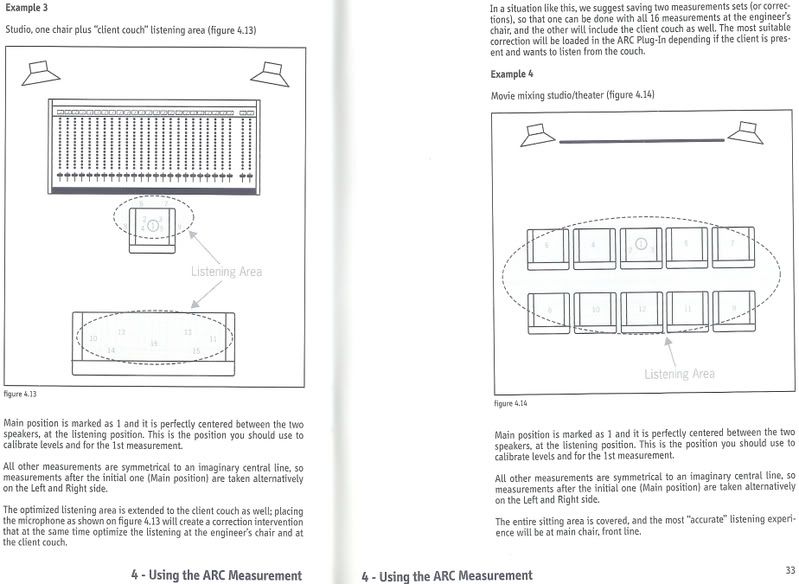


In this screen shot, you see the numbers showing how you should symmetrically move the mic around and how you should take your measurements. When you do this to the numbers and measure it all out, it's been fool-proof for me in all my tests. I even was able to fix my NS-10's that I had originally thought failed with this thing. What failed...was me. Anyway, you see all those mic placements in this diagram, right? If you branch out and do more in all the empty spaces, this (in my opinion as well as my experience) gives you even more of a proper sound anywhere you go in your room. If we took the 15 measurements they give us here and focus those 15 around the main sweet spot just like a pro room EQ would do, you're left with the exact same results but...as soon as you get out of that sweet spot zone, like pro room EQ, the sound changes drastically. If you do the 15 as they are and add-lib, there's not a bad spot in your room. It's just something you have to mess with and if you've never tried it and have room issues, the only thing I can suggest is to try it and compare mixes done without ARC and then mixes done with it. The only "remix" stuff I have to do these days is leveling when I need to fix one of my mixes. The eq's within my mix rarely change from the first mix I create. To me, that's 95% of the battle really. Levels are pretty subjective in the mixing field....but improper eq's can be the death of us. My old mixes without ARC had sub low rumbles and quite a bit of 200, 500-800hz that I just could not hear. The reason for this was because my room and monitors were not putting out the bass I needed to hear and this 500hz to 800hz deal was not present either which gave me a bit of mid-range congestion. My highs were always pretty good here...it was the bass and low mids that were absolutely killing me and mudding up my mixes. Hope this answers your question.

Bit: In your comment that read:

"The first question has to do with resonance, the primary reason small rooms have so many spectral problems. If you have a resonant null, that's something that is physically impossible to counter with equalization. And I don't use the absolute term "impossible" lightly."

There's no doubt in my mind you know what you're talking about. How it did what it did, I really can't answer that. The only differences in those 2 screen shots I showed was more mic placements and precise, accurate, symmetrical movements on the mic. I also adjusted the height using a mirror so it was about nose/ear level as close as possible. I swear to you none of those screen shots were photo shopped or edited in any way. My Adam screen shots look almost the same. I'll show ya measurements taken with the sub and without. I didn't save any of the bad Adam corrections so these are freshly done. The bad Adam corrections weren't bad "looking" I just got a phased type issue like what was mentioned on here a few times. Re-correction with the right measurements symmetrically, fixed that too. Here's a shot of them with and without sub using the latest software to correct with on the one that says 1,1 and the oldest version of my room corrected Adam's using the old software. The 1.1 you see means the room was corrected with the latest software which also is the software that added in that "full bass response" check box. That was not there in earlier versions and any correction made using a previous version of the software that was saved, will leave that check mark box greyed out and un-useable.
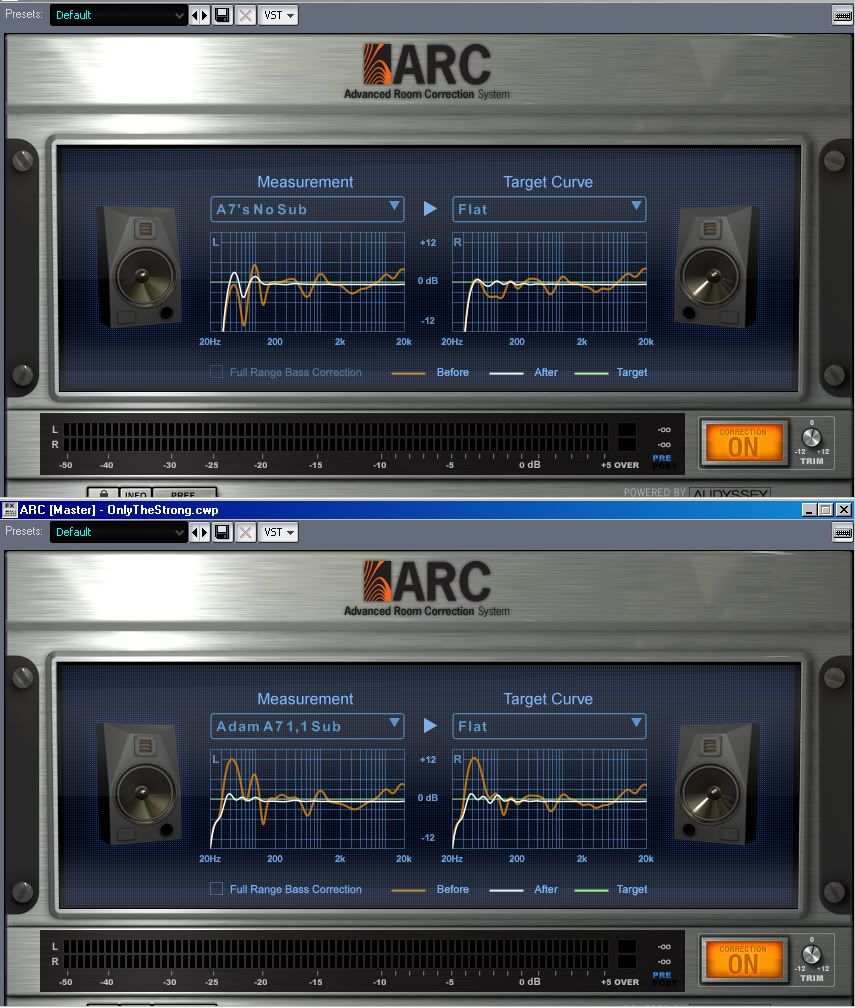


I can't tell you what it does or how it does it. Like I mentioned to Mike M, all I can say is it has made such a drastic difference, I can't even begin to tell you. Whether what it's doing is a scam that made me blow $499 or it's completely impossible, I leave that to people with more intelligence and experience in that part of the field. All I know is it made me realize I wasn't such a bad engineer after all because all my mixes prior to installing ARC made me look as well as sound, like a dude that would have no business ever sharing a song in an open forum let alone all the work I have done for clients while using this thing. I know how deep you and Mike M get into the logistics of this stuff and chances are, between the 2 of you, you'll find out how this thing works, what it's pros and cons are as well as if the wool had been pulled over my eyes and many others. But like I say man, whatever the case is or the final outcome, I'd be completely lost without this thing and my old mixes compared to what I've done post ARC are like night and day.

As far as corroborated ARC measurements by any other means.....the only thing I did was test it in a 2 million dollar studio that had proper traps and pro room correction. We did an A/B test to where the room EQ's that were permanently set could be disabled and we ran ARC in place of them. When the ARC corrections were done, all room eq's were disabled. When the engineer compared ARC to his room eq's, he smiled and immediately said "I can't believe it....this actually sounds better to me" and he went on to mention his problem areas as well as having to just know what to fix based on knowing his room and his monitors. He mentioned that he could hear what he had been compensating for while using ARC. He went out and bought it a week later and has been using it ever since. I've never done any waterfall plots or additional testing in my room, so God knows what story that would tell. LOL!!! But I do know that it really does make an incredible difference for me. Everything I mix sounds good on everything I play it through. My toughest sell is my Xbox 360 running and old Audiovox 5.1 rig. If something sounds good through that, it sounds good everywhere. It even sounds good on boom boxes as well as pricey car stereos and lame car stereos. So I don't know man....whatever it does, it does it well enough for me to get what I'm looking for at all times. A weird thing I noticed just last night (not that this will tell any stories or anything, but I found it strange) is when ARC is turned on, it sounds nearly identical to my AKG K 240 DF headphones with a bit more bass. The mids and highs sound like a mirror of those headphones and I had never noticed that before. Of course when I listen through those cans, ARC is disabled....and I know it's hard to tell what you get through cans as opposed to real monitors...but you know how it is man...you just learn your gear and you can tell when something just doesn't sound right. Like my Sennheiser HD 280 Pro's are completely different. They seem to accentuate lows and mids a bit more. But when I listen through the AKG's, I hear ARC in them even though it's disabled and there is a bit less bass at around 60hz. I wish it was something to where I could say "buy it Bit, if it sucks, I promise ya I'll buy it off ya" but it's one of those things that you only need one of. :(
2009/06/28 07:44:31
Billy Buck
ORIGINAL: Danny Danzi
I'm not implying you did a bad measurement job. I'm just saying that I sincerely believe your correction could be 100 times better if you decided to try it again and be as precise as possible using at least 18-20 measurements. As you can see, my example in the top half of my photo resembles yours a bit. A new measurement totally changed it and my speakers were not moved or altered in any way. But I'd definitely be concerned if I had the eq curve that you had.


I can attest to the fact that the ARC system will only be as effective as the time & effort put into getting it setup correctly in the first place. The first screen capture is a shot of the results I got from from not taking my time & doing a poor job setting of up & measuring my plot points around my listening position. I was especially unhappy with how my right speaker had a severe bass rolloff. The second screen capture shows the results after I went back and did (20) plot points (I properly measured & plotted each point using tape, made sure the mic was perpendicular and at the correct height at each measurement point, etc.) and slowly, methodically & meticulously measured my room. It took over an hour, but the results were well worth it. Since I have not changed my room (speaker placement, curtains, bookcases, etc) or my listening postion since then I am still using the same measurement profile 14 months later. Since using the ARC system I am comfortable knowing that what I mix in my room will sound just as good whether on my living room stereo, my car stereo or a boombox the first time. Before I would have to constantly go back and re-mix because I could not trust what I was hearing in my room.


2009/06/28 08:39:25
The Maillard Reaction

2009/06/28 09:20:40
Danny Danzi
No problem Mike...and I also appreciate the questions and insight you and Bit are adding to this. I just really wish there was a way for you guys to try it for yourselves just to see how it works in your realms without springing for it cash wise.

Hey Billy, thanks for chiming in here. I know you and I have had quite a few discussions about ARC. Glad to hear it's been working out for you. :) I gotta ask ya...in your screen shots, what the heck is that little tool bar at the top of your ARC plug with the +, Param, 2in 2 out, UI, 100% wet stuff all about?! LOL!! I don't have that and I want it just because...well it looks cooler and makes mine look incomplete! LMAO!!! What's that all about and what does it do if you alter that stuff up there?
2009/06/28 12:24:40
Billy Buck
ORIGINAL: Danny Danzi
I gotta ask ya...in your screen shots, what the heck is that little tool bar at the top of your ARC plug with the +, Param, 2in 2 out, UI, 100% wet stuff all about?! LOL!! I don't have that and I want it just because...well it looks cooler and makes mine look incomplete! LMAO!!! What's that all about and what does it do if you alter that stuff up there?


Oops.....sorry about that I should have captured a couple of SONAR screenshots. For expediency I just uploaded a couple of existing screen captures which I had used previously in a similar themed ARC thread on a R****R forum. LOL
© 2026 APG vNext Commercial Version 5.1

Use My Existing Forum Account

Use My Social Media Account