2015/03/13 15:57:16
bayoubill
Just think, if you had a recording of this you could pick out say a 4 bar phrase of it in Sonar and split it save it and have it to concentrate on. Slow it down and listen. Over and over  ... we can dream.... Just thinking
 
BEEPSTER - a pedal is a bass note that rings out below any of the notes being played 
                 Example - playing a open E bass string on the guitar and playing chords with the E is ringing at the same time
   
2015/03/14 17:27:32
bayoubill
3 Note Chords and the Charleston Rhythm
(if you already know jazz don't participate in this Fred!) 
 
I found thru much complaining from the horn section,experience, etc. that my chord voicing' s in the jazz context was not the proper sound. My background in Hendrix, ZZ Top, and Deep Purple just didn't sound right with the sax/trombone/ or trumpet sections
I learned 3 note chords sounded best. What follows will lead to using your best blues licks on jazz changes 
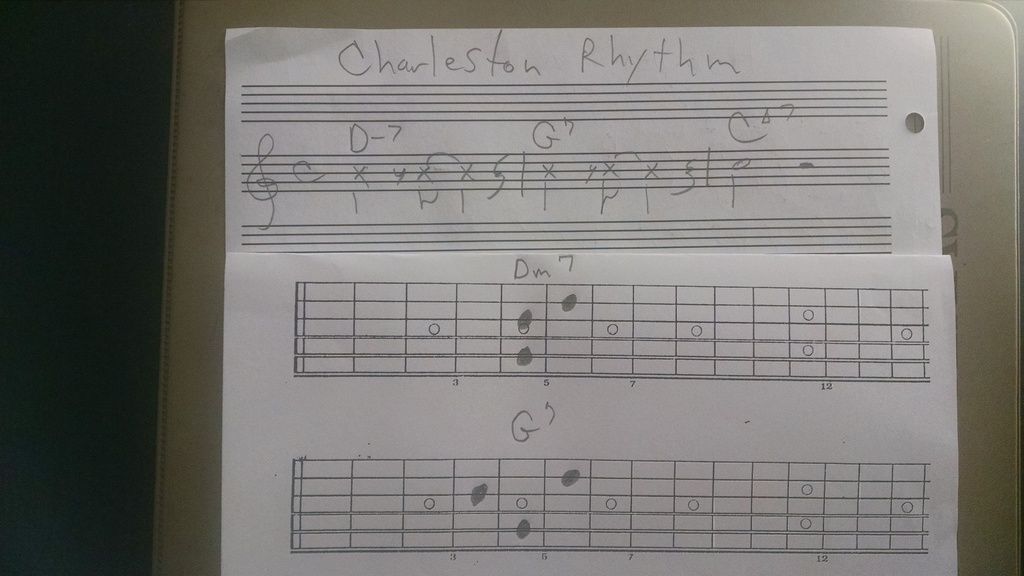


Record the above changes in Sonar with your guitar at about 92 bpm. Make sure no other notes are sounded other than shown. You can play just the Dm7 to G7 and loop it  or play the Dm7 To G7 and resolve to the CM7 if you want. It will benefit you to practice these chords if you don't use them. COPY THIS PHOTO IF NEED FOR REFERENCE
 Have fun !
 
P.S> You don't need to record any thing else with this. Just your guitar
 
BEEPSTER - an Example of a pedal tone can be heard in this song 2nd break
 Example
2015/03/14 19:29:05
sharke
3 note voicings on guitar are very useful, I think they came out of the Big Band era. I found it very useful to learn all fingerings of the standard chords (maj, min, 6th, maj7, min7, dom7) in each inversion on the low E, D and G strings. You can get so much mileage out of these and I find myself using them in all styles of playing. 
2015/03/14 19:49:33
bayoubill
Now let's start getting to what this Fred is intended for:
 
Pick up your guitar and play a 2 bar blues lick in A. Think an A blues lick. Keep playing till you got a good sounding one you're happy with. Or you could just play your favorite lick in A blues. Get it under your fingers
 
 Now put down your guitar and pull up that 3 note Dm7 to G7 clip you did in Sonar. Play your blues lick. Listen to the SOUND with the changes. 
 
next vary the rhythm of the lick with the changes.
next play another blues lick.  vary the rhythm    
 
Listen to the sound . No need to analyze anything. Just play and listen. Record it with the changes and listen without playing. Stay with A blues that you know but keep it A Blues. I will introduce that A blues to other jazz changes later
2015/03/15 12:40:36
bayoubill
If there is anyone needing or using this Fred let me know and I will keep adding to the info. If not I hope what has been written above has helped someone. If you want to hear what 3 note chords sound like in a musical context click on SONGS link below and listen to Autumn Leaves. It's full of 3 note chords
 
P.S. I must mention I had to play Autumn Leaves in Am ...........   we all know why 
2015/03/15 13:00:31
Zonno
Yes, thanks Bill!
I think it is interesting.
I play some Jazz, but I learned all the chord arpeggio's and I play them along with the chord changes.
Sometimes I use octotonic scales or wholetone scales on the V.
I realise I never studied the alt scale, (the transposed melodic minor).
So that what I will begin to do.
 
 
2015/03/15 13:50:05
tom1
Good stuff, Bill.

As a music major in college many years ago I remember reluctantly playing in the jazz band and since I only knew blues and rock licks I remember some very strange looks from the other musicians.

I learned a few things:

I eliminated bar chords and open chords.
Jazz chords, as you know, have completely different fingering positions and in many cases eliminate the first and second guitar strings altogether.

Once I learned jazz chording it was much easier for me to think and perform jazz solos.

Also I remember being told to think outside the box. For instance, soloing in a Bb major scale as the band played in a different key altogether. Or soloing in a different time signature.
 
Keep the thread going Bill;  maybe one day jazz will actually be popular.     :)
2015/03/15 14:06:14
bayoubill
I will introduce the Altered Scale sound as it relates to our A blues scale then.
The Dominant 7 Altered chord is a chord with a root, 3rd, and flatted 7th  flatted 7th meaning it's a note 2 frets below the root (chord name) normally above it an octave and altered notes and all the extensions above that altered including the 5th
Chord tones are the 1st, 3rd, 5th, and b7( lower case b is used to show a note on the guitar lowered 1 fret) of the scale.   An Altered dominant 7th chord is always a movement to the I chord (V7 function) away in a progression because it doesn't sound good repeated or sustained very long. It has to go somewhere. It's a Dominant sound 
(An exception to this is the 7#9 chord sometimes called the Hendrix chord)
 
Chord tones - 1 is root (2, same as 9th)  3 (4,same note as the 11)  5  (6,same as the 13)  7th  8(octave) 9 10(same as 3rd)   11 ( 12 same as 5th)  13 (same as 7th) 14(octave) 


2015/03/15 14:42:53
bayoubill
The Altered Dominant 7th Sound Using the Blues Scale
If you already know jazz theory this Fred is not for you
 
We played our A blues lick over the Dm7 to G7 to CMaj7 with the Charleston rhythm and checked out the sound with the help of Sonar. (you could have vamped the Dm7 to G7 only)
 
Now let's get jazzy!
 
Play an A blues lick 4 beats then repeat that lick one fret up for 4 beats then move it up another fret 4 beats. You don't have to play it exactly the same each time. Play the lick , move up one fret , play the lick . move up one fret
 
What you have now is one bar A blues/ one bar Bb blues/ one bar B blues
 
Get it under your fingers
 
 
Now play it with the Dm7 to G7 to CMaj7 clip and LISTEN to the sound
 
Record what you play and listen to it. Then play and record it again and listen


2015/03/15 16:22:10
Beepster
I have been somewhat preoccupied with various other mayhem, Bill but I will indeed be bookmarking and slamming away at the material you have posted here (and anything else that is forthcoming) when I get the chance. I thank you for sharing and making the effort. I'm sure many others (including many lurkers) will make use of these lessons and really it is always nice to create an intertube archive of personal knowledge like this for others to learn from and enjoy. It balances out all the poop jokes and pr0n out there on the world wide wooblywobs.
 
Cheers.
© 2026 APG vNext Commercial Version 5.1

Use My Existing Forum Account

Use My Social Media Account