Why extra headroom is needed for MP3s
It's a nasty gloomy, rainy Sunday here in the Pacific Northwest, a good day for reading a book. Unfortunately, I have no new books to read, so I went back to some old favorites and was reading up on MP3 compression. Hey, I'm a hopeless geek, what can I say?
I decided to do some experiments to test a well-known truism, that you need to leave extra headroom when mastering for MP3s. It's true, by the way.
Here's a piece of an audio file in which Ozone has done its job of limiting output (in this case, to -1db, my longtime standard). Despite being a fairly highly-compressed section (about -9db RMS), no samples exceed -1db (the horizontal white line represents -1db):
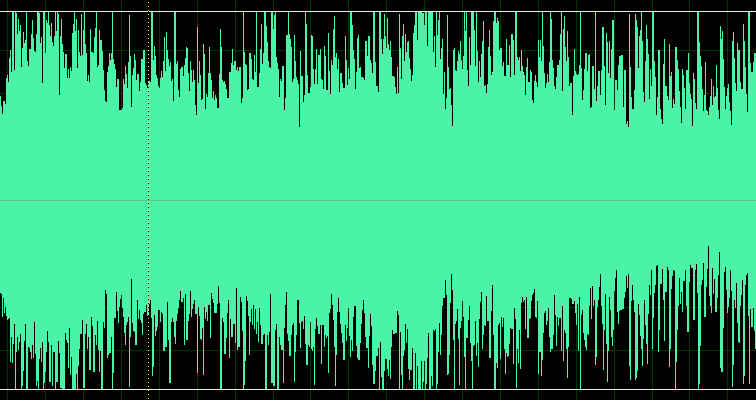
Now here's a section of the same file that's been encoded to a high-quality MP3:
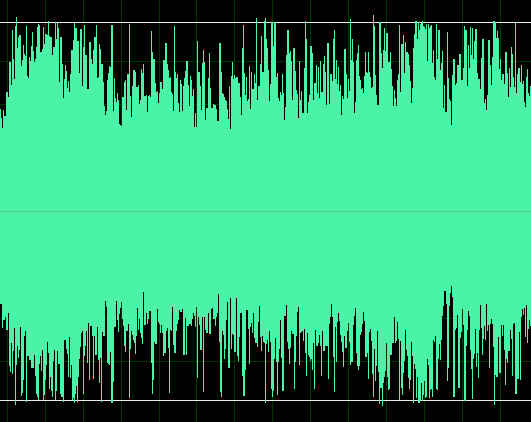
Note that a few peaks now exceed the previous limit. Fortunately, they're not overs because my conservative -1db limit left enough headroom to absorb these new peaks.
This phenomenon gets worse - much worse - with lower-quality MP3s. Below is the same song, this time encoded to 128Kb/s, CBR. Not the lowest quality, but representative of what Soundclick provides with a free account.
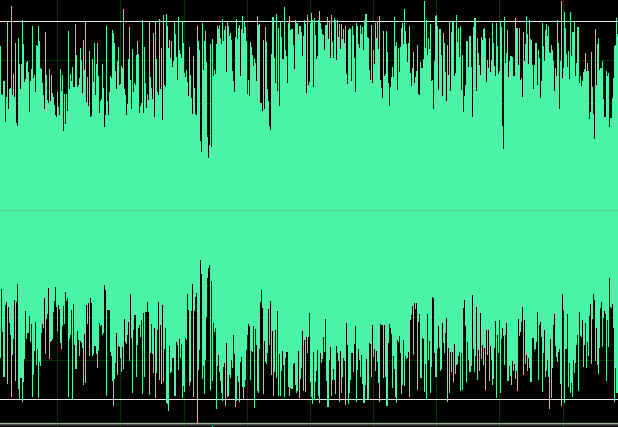
Note that many peaks now exceed the old limit, and in fact some of them are actual overs. The peaks have somehow grown by more than 1db.