name1432 
Max Output Level: -85 dBFS

- Total Posts : 295
- Joined: 2005/02/15 19:02:47
- Status: offline

RE: Tape Saturation: Theory
2005/06/24 00:48:22
(permalink)
that makes sense to me, so I'd think people would be looking forward to the era when virtually the same CD can be produced entirely within a daw -- maybe not as good a final product as if you invited an audience into a studio to listen to tape over monitors -- but every bit (literally) as good as any CD produced with high end analog equipment
post edited by name1432 - 2005/06/24 00:57:30
|
ohhey
Max Output Level: 0 dBFS

- Total Posts : 11676
- Joined: 2003/11/06 16:24:07
- Location: Fort Worth Texas USA
- Status: offline
RE: Tape Saturation: Theory
2005/06/24 01:21:53
(permalink)
ORIGINAL: name1432
that makes sense to me, so I'd think people would be looking forward to the era when virtually the same CD can be produced entirely within a daw -- maybe not as good a final product as if you invited an audience into a studio to listen to tape over monitors -- but every bit (literally) as good as any CD produced with high end analog equipment
The problem these days is not making a great recording but keeping it that way. If you let one of those so called mastering houses run it through their "major label quality" systems it will just be squashed to bits (ha ha) and any difference between analog and digital won't matter. Or worse all anyone ever hears is an mp3...  The ads for mastering houses crack me up. They promise "major label quality".. I fell like calling them up and asking "Can't you do any better then that ?" 
|
DonnyAir
Max Output Level: -66 dBFS

- Total Posts : 1201
- Joined: 2004/12/18 16:37:31
- Location: Akron, Ohio
- Status: offline
RE: Tape Saturation: Theory
2005/06/24 07:53:24
(permalink)
Yeah, a recording made on analog tape and then mastered to CD will sound different and arguably better than an all-digital recording mastered to CD, just as a recording of a guitar played through a genuine tube amp and played back on a solid-state sytem will sound better than a guitar played through an overdriven home stereo and then played back on the same system. Make sense? Leave it to Yep to say it much better and to the point than my rambling post did... I apologize for getting carried away. The problem these days is not making a great recording but keeping it that way. If you let one of those so called mastering houses run it through their "major label quality" systems it will just be squashed to bits (ha ha) and any difference between analog and digital won't matter. Or worse all anyone ever hears is an mp3...
The ads for mastering houses crack me up. They promise "major label quality".. I fell like calling them up and asking "Can't you do any better then that ?" Also very valid. But I'm already on the record in numerous other posts/threads regarding my feeling and frustration with the current "pro" trend of "squashing". I'm off to Canada.... have a great weekend everyone. D.
|
name1432
Max Output Level: -85 dBFS
- Total Posts : 295
- Joined: 2005/02/15 19:02:47
- Status: offline
RE: Tape Saturation: Theory
2005/06/24 08:24:32
(permalink)
ORIGINAL: DonnyAir
BTW.. I haven't gotten rid of my decks and still do, from time to time, multi track and mix to them, and yes, as far as my ears are concerned, there's a big difference.
I thought some more and realized at least one tape effect that can't be simulated. Suppose you record onto tape. If your pathway is all analog, the tape captures ultrasonic frequencies. Then as you mix on tape, some of the ultrasonic energy gets smeared down into the audible frequency range. I'm totally speculating here, but that effect might occur, and might please some listeners. On the other hand, if your original tracks are captured at 48K digital, even if you mixed on tape, the no ultrasonic frequencies would be fed to the mixer, so the mixer would have nothing to smear from ultrasonic down into audible. I still believe a digital computer could in theory do a great job of emulating an analog mixer, but even if mixer-emulation were perfect, it could never recover the ultrasonic info lost when when using a digital recorder if anyone's ever recorded digitally and then mixed on tape, i'm wondering whether the result had the good analog stuff or was missing it (or something in between). This is rhetorical, unless anyone happens to have tried it. Please dont appologize for anything you've written, Donny, I learn from answers to questions I hadn't thought to ask, so your and anyone's experience is greatly appreciated
post edited by name1432 - 2005/06/24 08:32:27
|
kylen
Max Output Level: -79 dBFS

- Total Posts : 578
- Joined: 2003/11/25 19:30:06
- Location: Southern WV, USA
- Status: offline
RE: Tape Saturation: Theory
2005/06/24 12:44:59
(permalink)
This one is out of my price range (I'm generally a $99 guy) - anyone heard the mcdsp analog channel? http://www.mcdsp.com/products/analogchannel/
The Analog Channel Emulator AC2 plug-In is an emulator of the most popular analog tape machines (and tape mediums) known to the professional audio recording industry. Playback systems from Studer, Otari, MCI, Ampex, Sony, and Tascam are available in a single 'reproducer' (*). Modern and vintage tape formulations, IEC standards, and tape saturation release (not found on any other 'reproducer') round out the control section of the world's most flexible tape playback/recorder.
Standard tape machine parameters such as bias, playback speed, and IEC1/2 equalization are provided. Control well beyond the limits of the 'reel-world' devices includes adjustable low frequency roll off and head bump - independent of playback speed. You can select from several playback head types, and even control the rate at which tape saturation is dis-engaged. And instead of frequency sweeps and test tones, the playback head and tape saturation responses are displayed in realtime - updated with every control change.
Sounds interesting, yes?
|
alanfc
Max Output Level: -88 dBFS

- Total Posts : 107
- Joined: 2003/12/05 18:22:39
- Location:
- Status: offline
RE: Tape Saturation: Theory
2005/06/24 14:46:29
(permalink)
hi,
just experimenting with this Cakewalk FX-2 Tape Sim effect. I have no budget to buy anything new right now.
It has a couple options for tape speed and light-heavy saturation.
I know theres a million Warming products out there but I never see any discussion of the actual Frequencies that are affected. Something about harmonics and saturation etc. but no numbers.
This Cakewalk one brightens and distorts things in a signficant way. I'm just curious. It seems like its just a big boost at the high end of the spectrum? I'm oversimplifying.
I like it actually, its like a big blanket has been removed from my tracks. Without tweaking though, it's nasty.
So as part of my edu. on frequencies- what am I hearing saturation or some fake frquency boost?
thanks
|
yep
Max Output Level: -34.5 dBFS

- Total Posts : 4057
- Joined: 2004/01/26 15:21:41
- Location: Hub of the Universe
- Status: offline
RE: Tape Saturation: Theory
2005/06/24 15:08:29
(permalink)
ORIGINAL: alanfc
hi,
just experimenting with this Cakewalk FX-2 Tape Sim effect. I have no budget to buy anything new right now.
It has a couple options for tape speed and light-heavy saturation.
I know theres a million Warming products out there but I never see any discussion of the actual Frequencies that are affected. Something about harmonics and saturation etc. but no numbers.
This Cakewalk one brightens and distorts things in a signficant way. I'm just curious. It seems like its just a big boost at the high end of the spectrum? I'm oversimplifying.
I like it actually, its like a big blanket has been removed from my tracks. Without tweaking though, it's nasty.
So as part of my edu. on frequencies- what am I hearing saturation or some fake frquency boost?
thanks
You're hearing some compression and even-order harmonic distortion-- basically the plugin is introducing additional harmonics to the frequency of the recorded material. These harmonics roughly coincide with pleasing intervals such as octaves, fifths, fourths, and natural thirds. The sound becomes brighter, fuller, and livelier. Overdoing it will give your listeners a headache. Cheers.
|
ohhey
Max Output Level: 0 dBFS
- Total Posts : 11676
- Joined: 2003/11/06 16:24:07
- Location: Fort Worth Texas USA
- Status: offline
RE: Tape Saturation: Theory
2005/06/24 15:16:34
(permalink)
ORIGINAL: yep
...
You're hearing some compression and even-order harmonic distortion-- basically the plugin is introducing additional harmonics to the frequency of the recorded material. These harmonics roughly coincide with pleasing intervals such as octaves, fifths, fourths, and natural thirds. The sound becomes brighter, fuller, and livelier. Overdoing it will give your listeners a headache.
Cheers.
It sounds like the thiner your mix sounds before it hits the plugin the more improvment you will hear and the better it will sound. Kinda' like a thin sounding start or tele often sounds better with some distortion pedals then a fat sounding Les Paul. You don't want fat being made fatter, you want thin being made fat in one pass.
|
ed_mcg
Max Output Level: -48 dBFS

- Total Posts : 2741
- Joined: 2004/04/26 11:22:59
- Location: Minneapolis
- Status: offline
RE: Tape Saturation: Theory
2005/06/24 15:22:41
(permalink)
|
ohhey
Max Output Level: 0 dBFS
- Total Posts : 11676
- Joined: 2003/11/06 16:24:07
- Location: Fort Worth Texas USA
- Status: offline
RE: Tape Saturation: Theory
2005/06/24 16:02:04
(permalink)
ORIGINAL: ed_mcg
even-order harmonic distortion
For your reading enjoyment: 3M's Views on harmonic distortion.
(Don't let these guys sneak in and calibrate your decks!)
Good GOD !! how old is this document ?
|
name1432
Max Output Level: -85 dBFS
- Total Posts : 295
- Joined: 2005/02/15 19:02:47
- Status: offline
RE: Tape Saturation: Theory
2005/06/24 16:57:43
(permalink)
ORIGINAL: alanfc
I know theres a million Warming products out there but I never see any discussion of the actual Frequencies that are affected. Something about harmonics and saturation etc. but no numbers.
This Cakewalk one brightens and distorts things in a signficant way. I'm just curious. It seems like its just a big boost at the high end of the spectrum? I'm oversimplifying.
I like it actually, its like a big blanket has been removed from my tracks.thanks
if you get really curious, you could: 1. start with a one clean audio track 2. clone it, including the audio data 3. set up your mixer so the master is summing your two souce tracks 4. add the effect to one of your source tracks 5. phase invert one of your source tracks effectively, the mixer apply the effect and then subtract out the original, so on the master bus you hear only frequencies that have been affected by your plug in then if you want, you could run the result through a spectrum analyzer and look at the frequencies digital-saturation fx have the potential to add frequency-aliasing to a mix. I don't mean that every saturator does this, but maybe that is one reason that not all saturation plug ins sound as relaxing
|
alanfc
Max Output Level: -88 dBFS
- Total Posts : 107
- Joined: 2003/12/05 18:22:39
- Location:
- Status: offline
RE: Tape Saturation: Theory
2005/06/24 17:24:04
(permalink)
Cool thanks- since I posted I've gone home to work with it some more and found some reasonable settings - this is really cool I had no idea this is what the warmth/saturation/tape deal was all about. Now on to shopping for some 
|
7string
Max Output Level: -89 dBFS

- Total Posts : 89
- Joined: 2004/08/03 17:29:55
- Status: offline
RE: Tape Saturation: Theory
2005/07/05 23:20:40
(permalink)
Here's an outboard tape emulator from Rupert Neve. Maybe he's on the right track? http://www.rupertneve.com/porticorange.html $1440 is still cheaper than buying a tape machine with all the extra maintenance and tape cost. Just a little more than a nice mic pre.
|
gullfo
Max Output Level: -86 dBFS

- Total Posts : 232
- Joined: 2004/10/15 01:48:08
- Location: Old Tappan, NJ
- Status: offline
RE: Tape Saturation: Theory
2005/07/06 12:37:51
(permalink)
what would be cool is a box that has some really nice electronics in it along with good quality heads and bias controls with a tape loop... say 8 tracks... that you could "plugin" as a means of adding real tape warmth... basically the record and playback heads would have to be close enough to keep latency down :-) or some plugin in the track would compensate for it... on each loop the tape would get erased and you could buy tape loops to drop in as the tape wears... almost like a space echo but 8 tracks + hi-fi so it could be patched in... sell if for about $1,800 for the entry level, $12,000 for the pro version... :-) EDIT oops... never mind... just saw the rupert post... not really tape but sounds like it has most of the features... even less money :-)
post edited by gullfo - 2005/07/06 12:43:46
|
nbnspire
Max Output Level: -88 dBFS
- Total Posts : 131
- Joined: 2004/05/24 09:32:32
- Location: Kentucky
- Status: offline
RE: Tape Saturation: Theory
2005/07/06 15:58:41
(permalink)
So, what about mastering to tape? I've read and heard many folks mixing down their stereo mixes to analog during mastering. Is it too late by then to grab some of that "warmth" or does it still "help" the mix (assuming of course it is done correctly)?
|
DonnyAir
Max Output Level: -66 dBFS
- Total Posts : 1201
- Joined: 2004/12/18 16:37:31
- Location: Akron, Ohio
- Status: offline
RE: Tape Saturation: Theory
2005/07/06 16:12:42
(permalink)
So, what about mastering to tape? I've read and heard many folks mixing down their stereo mixes to analog during mastering. Is it too late by then to grab some of that "warmth" or does it still "help" the mix (assuming of course it is done correctly)? You can certainly do this, and it might give you a bit of that tape "sound", but it won't have the sonics to the degree that you would have if you also tracked to tape to begin with. Every time the signal passes through a converter, whether it's on it's way out of digital, or on it's way in, at some point you'll face the "sampling" stage. This is, as we know, where the audio is "cut up" into 44 thousand pieces of data, this is where dithering is added, etc. I'm not saying your idea is a bad one Nelson, but there's still going to be that "uneven" harmonic distribution somewhere, as long as you are in the digital realm. I need to clarify one more time that I'm not bashing digital. It's convenient as all heck, and has more flexibility in the production stage than analog ever had, I'm just saying that while I'm not knocking digital, there are days when I miss tracking to 1 or 2 inch and mixing it down to a 1/4 or 1/2" reel at 15 /30 ips and smashing that meter to plus 9! LOL.. it's a sound I do miss. But, it's digital world we live in, for better or for worse. FWIW D.
|
Joe Bravo
Max Output Level: -56.5 dBFS

- Total Posts : 1870
- Joined: 2004/01/27 14:43:37
- Status: offline
RE: Tape Saturation: Theory
2005/07/11 16:37:13
(permalink)
Well, like the guy said about never wanting to touch a razor block again...ditto! But really, aside from drums on hard rock tunes, I can't think of anything that benefits from tape saturization. I think its easy to duplicate. Just drop all the highs above 14k and give it a bass bump around 250hz. Then run it through some compression. I never want to see a reel of tape again! Call me pampered.
|
DonnyAir
Max Output Level: -66 dBFS
- Total Posts : 1201
- Joined: 2004/12/18 16:37:31
- Location: Akron, Ohio
- Status: offline
RE: Tape Saturation: Theory
2005/07/11 16:50:08
(permalink)
But really, aside from drums on hard rock tunes, I can't think of anything that benefits from tape saturization. I think its easy to duplicate. Just drop all the highs above 14k and give it a bass bump around 250hz. Then run it through some compression. Man.... Joe, I don't know what decks you had experience with, but that thing about dropping all the highs above 14k and giving a low end bump of 250 to emulate the sound of tape couldn't be further from the truth. I mean, are we talking about your experience with a Tascam Porta One here ? On a pro deck, the ultra high frequencies were not only reproduceable, (20k+) but sounded better because of the even-order harmonics involved. The "air" , transparency and warmth on vocals absolutely shined on analog and there were times that a tube or class A pre wasn't even needed to obtain this. Again..I miss my editing block and razor blade like I miss my ex wife, but as far as the sound goes, I can't see how you justify these comments. But...one man's treasure is another man's trash I suppose. D.
|
chaz
Max Output Level: -47.5 dBFS

- Total Posts : 2775
- Joined: 2004/02/03 12:08:00
- Location: Tampa, FL
- Status: offline
RE: Tape Saturation: Theory
2005/07/11 18:53:11
(permalink)
ORIGINAL: DonnyAir
But really, aside from drums on hard rock tunes, I can't think of anything that benefits from tape saturization. I think its easy to duplicate. Just drop all the highs above 14k and give it a bass bump around 250hz. Then run it through some compression.
Man.... Joe, I don't know what decks you had experience with, but that thing about dropping all the highs above 14k and giving a low end bump of 250 to emulate the sound of tape couldn't be further from the truth.
I mean, are we talking about your experience with a Tascam Porta One here ?
On a pro deck, the ultra high frequencies were not only reproduceable, (20k+) but sounded better because of the even-order harmonics involved.
The "air" , transparency and warmth on vocals absolutely shined on analog and there were times that a tube or class A pre wasn't even needed to obtain this.
Again..I miss my editing block and razor blade like I miss my ex wife, but as far as the sound goes, I can't see how you justify these commen Glad you addressed it, Donny, because I was about to. I do not miss having to align the heads, calibrate the machine, splice tape..... which I never liked in the first place!..... etc, but I have brought my analog decks back into the CR for the very reasons you state above. Now I am waiting for my ADC punchdown patchbays to arrive so I can hook it all up.
|
Joe Bravo
Max Output Level: -56.5 dBFS
- Total Posts : 1870
- Joined: 2004/01/27 14:43:37
- Status: offline
RE: Tape Saturation: Theory
2005/07/12 20:40:11
(permalink)
Well, I guess we're just gonna have to disagree on this one. As far as equipment goes, I, like most home recording folks was running semi-pro Tascam gear at 15ips. At 15ips on smaller tape i.e.--16 tracks on 1", 8 tracks on 1/2", 4 tracks on 1/4", etc., the high end maxed out at 20k. Not that anybody ever hit 20k with it. At least not by the time your patch bay, your old 12-bit Alesis reverb, and not to mention your compressor, stole your highs. Then proceed to "whack the signal at +6db", and there's no way in hell (excuse me ladies--"heck") your gonna get past 14k.
As for the bass bump, What analog deck did you ever see that didn't produce a bass bump?
I could never afford Studer or Otari decks and don't know anyone without a mob connection in LA that could. My first good tape deck was a 4-track Teac A3440S. It came out in 79/80 or thereabouts and cost around 2-grand as I recall. Then I shelled out another $600 for a used DBX NR unit that was made specifically for this machine. It pumped and breathed like crazy and aslo exagerated the bass bump (around 70 hz) even more.
Now that brings me to another question: At 30ips, virtually all tape decks have a bigger drop off in the low end and a bass bump that was higher (I might have exaggerated "at 250K" but I know darn well they produced a bump over 100k at least). I never had the opportunity to record with a machine that would do 30ips but I was always under the impression that most people hated tracking drums at that speed because of the ridiculous bass bump on the kick. Atop of that, most people I knew were using some kind of NR unit with their decks. And all NR units are going to exagerate bass bumps and kill off at least a little of the highs. It wasn't just DBX that did that. The only 2 studios I was aware of in the St. Louis area back then (early 80's) was Smith-Lee, and Swing City, and they both ran their 2" 24-track machines at 15ips like everbody else. Running at 30ips gave you highs a little above 20k, which was useless and inaudible, but lost you lows that were quite audible. I'm sure there were a few really high end decks that had a little flatter frequency response at 30ips than others but nonetheless, most decks got you better overall performance at 15ips. So..............
Can I assume you guys were also recording at 15ips just like me, were using some kind of NR unit just like me, and had a high end barrier of 20k just like me? And that you used a patch bay just like me, and had enough sense to run compressors in your drums board channels just like me? Just how on earth did you come close to 20K in the first place even at 0-VU? Because I never could. Now bang the meters at +6-VU and tell me you're getting 20k plus.
Sorry, but I don't buy it.
|
Nate
Max Output Level: -76 dBFS

- Total Posts : 726
- Joined: 2003/11/09 03:56:02
- Location: North Carolina
- Status: offline
RE: Tape Saturation: Theory
2005/07/15 22:52:26
(permalink)
ORIGINAL: DonnyAir
PS.... I haven't found a plug in sim yet that sounds like analog tape does when you whack it hard at +6... have tried many, and might be, AFAIC, the one exception to my opinion that plugs are better than hardware...perhaps it's out there, but I haven't found it.
D.
Whack it hard at +6??? MY G*d man....that's not just a whack, that's a direct shot with a ballpeen hammer!<G> What the heck were you recording? And how often did you align the heads? PapaNate
|
Nate
Max Output Level: -76 dBFS
- Total Posts : 726
- Joined: 2003/11/09 03:56:02
- Location: North Carolina
- Status: offline
RE: Tape Saturation: Theory
2005/07/15 23:05:09
(permalink)
At 30ips, virtually all tape decks have a bigger drop off in the low end and a bass bump that was higher (I might have exaggerated "at 250K" but I know darn well they produced a bump over 100k at least). It wasn't that bad, but I agree there was a difference between the two. To be honest most of the time in the smaller stuido's the difference was the engineer and not the decks. There were many people with more money than skill who couldn't properly allign the heads on any deck, and then would scream about the *drop offs* and crap like that. I never had the opportunity to record with a machine that would do 30ips but I was always under the impression that most people hated tracking drums at that speed because of the ridiculous bass bump on the kick. Again...*hated*??? that's a to strong...becuase for every bass player and drummer wishing for 15ips, there were 50 times more singers and songwriters who like the clarity that 30ips would impart to vox. Since songwriters paid the bills...30ips was used. most decks got you better overall performance at 15ips. So.............. One of the main reason wasn't performance, but tape cost. More time at 15 than 30. Another reason was how guitars and drums sounded when spread out over more tape. Just how on earth did you come close to 20K in the first place even at 0-VU? True 20k response didn't make it on to the LP's or most of the speakes they were played though..... let along to the tape decks that were used to record stuff.There's a nice sounding bandwidth limit to tape that I find pleasing. However there were a bunch of Direct to Disc releases that had astounding freqency response. PapaNate
post edited by Nate - 2005/07/16 14:45:17
|
Joe Bravo
Max Output Level: -56.5 dBFS
- Total Posts : 1870
- Joined: 2004/01/27 14:43:37
- Status: offline
RE: Tape Saturation: Theory
2005/07/20 21:10:59
(permalink)
There were many people with more money than skill who couldn't properly allign the heads on any deck, and then would scream about the *drop offs* and crap like that. Well, the biggest problem in those days (before ADAT and cheaper gear started to emerge) was that the cost of the machines was so ridiculous that almost nobody could afford more than 8-tracks on Tascam decks until Fostex came along, but that was further hampered by the price of decent mics. Most home recordests were trying to get by with dynamic mics because that was all we could afford. Condensers were $2,000 and beyond. I bought that Peavey-PVM48 when it came out thinking it was a real God-send. AKG made it for Peavey and I think it was the first electret condenser mic ever made. I paid $250 for it and thought, "Maybe now I can finally get a good acoustic guitar tone." It did sound better than a SM57 or 58, but it was still nowhere near a real condenser. And all those dynamic mics made the bass bump even worse. This was especially true on Tascam decks, which had a worse bass bump than anything else out there. Improper biasing was the worst culpret for bad frequency repsonse though in my opinion. for every bass player and drummer wishing for 15ips, there were 50 times more singers and songwriters who like the clarity that 30ips would impart to vox. Since songwriters paid the bills...30ips was used. Hmm...I disagree. I might well be wrong but it seemed to me that 15ips was used almost univerally on any multitrack machine above a good half track. Some of the half tracks seemed to do a little better at 30ips than their mutitrack counterparts, however, virtually every machine ever made had a better graph at 15 than 30. I found a few charts. The following isn't on my web server so it may not show up here. If not I'll upload to my server along with several others after the first of the month. But if you can see it, it shows the 30ips curve in red and 15ips in blue. Now, this is a great machine with less peaks and dips than just about anything I've seen before. Most decks didn't have a line anywhere near as flat as these. The blue 15ips curve is obviously better for anyone recording music. Not a lot better, but better. This is from an exceptional Sony APR-5000 1/2" half track, but its fairly typical of graphs for all decks. I mean, they all have different (and usually much bigger) peaks and dips, but virtually any deck should give a more usable frequency response at 15ips. The only decks I know of that were used at 30ips were wide format half track mixdown decks. But even most of them were run at 15ips to the best of my knowledge. 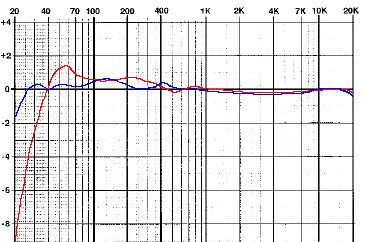 There's a nice sounding bandwidth limit to tape that I find pleasing. There's a nice sounding bandwidth limit to tape that I find pleasing. Everybody does. Its mostly the warmth of that bass bump, and the cutting off of highs tends to take out some of the grit factor. But we can do the exact same thing with digital waves using a little EQ. It ain't rocket science.
post edited by Joe Bravo - 2005/07/20 21:19:16
|
yep
Max Output Level: -34.5 dBFS
- Total Posts : 4057
- Joined: 2004/01/26 15:21:41
- Location: Hub of the Universe
- Status: offline
RE: Tape Saturation: Theory
2005/07/21 01:29:28
(permalink)
Analog tape is capable of faithfully recording signals well above 40k on the high end all the way down to DC (0Hz) on the low end. The fact that a particular tape recorder or signal path could not does not, in and of itself, prove that tape is inferior to to digital. Ferrous oxide particles on plastic tape have no particular affinity for 50Hz or 200Hz or any other frequency. There are a lot of reasons why gear manufacturers either allow or deliberately introduce certain kinds of distortion into the equipment they send out. Fidelity is still a somewhat subjective measure, at the end of the day. Use a digital measuring device to measure a digital signal and of course it will come out perfect. Use an analog measuring device on a digital signal and it will reveal, at the least, quantization and truncation error. Use an analog measuring device on an analog signal and it will reveal discrepancies between the measuring device and the signal path. Use a digital measuring device on the analog signal and it will reveal, at least, the noise of unassigned electrons moving through the system. The real acid test is to play the signal for the listener and ask which sounds more real. Sometimes it takes a lot of illusion to create a convincing reality. Cheers.
post edited by yep - 2005/07/21 01:35:19
|
johndale
Max Output Level: -43 dBFS

- Total Posts : 3228
- Joined: 2004/03/02 15:11:37
- Location: Red Bluff, California
- Status: offline
RE: Tape Saturation: Theory
2005/07/21 03:28:11
(permalink)
What do any of you old timers remember about the Fostex 250? I bought that one and I'm having problems RANDOMALY with it recording. Can any one help?....................JDW
|
MightyLeeMoon
Max Output Level: -80 dBFS

- Total Posts : 513
- Joined: 2003/12/18 16:24:39
- Status: offline
RE: Tape Saturation: Theory
2005/07/22 08:53:45
(permalink)
Damn... I knew someone was gonna get around to asking me that sooner or later...
Okay... here goes.... if forced to choose....
Tape.
But not because I'm "stuck in the past", or for some other similar reason.
Actually, I jumped into digital in the mid '90's with both feet, impressed by the convenience, the noise floor, the fact that you don't have to align a PC platform, or relap head stacks, you don't have to actually cut tape with a razor and grease pencil to edit.. (there is no "undo" once you've sliced that tape!), the time available is pretty much limited only to your computer's memory, and not because only so much tape will fit on a reel (on a 2500 ft reel, only about 33 minutes or so running at 15 ips, only 15 or so at 30 ips, ), all those reasons are just some of the many why I went digital... but I've never been able to replicate the sound... I've tried, God knows I've tried, I just can't do it.
From a business standpoint, digital is better if only looking at the cost of tape. As I said above, a reel of 456 (or 499, or whatever) running at 15 ips will only give you a little over a half hour of recording time. Man, you could eat that up just doing 5 or 6 takes of one song, and at $100 bucks a reel, well, clients on the lower level freak out at $55.00 per hour of time. Add the tape cost and they hit the roof. Ask me how I know..LOL..
Also, editing is certainly a breeze, like I said, if you're cutting tape and you botch it, yeah, you can fix it, but not as fast as you can by simply hitting "undo" with the click of a mouse.
In some ways, digital is wonderful because it has brought possibilities within reach of everyone who wants it, from the solo songwriter, to a 15 piece band, and the quality is, for the most part, very consistant if you know what you're doing.
But, the above reasons are also why it's become a hindrance as well... the knowledge that used to accompany recording and it's inherant techniques are slowly dissipating, IMHO.
but... I've strayed from the question... it's the sound that I miss...that warmth that you get when you pound your meters to +6 or even +9... and I haven't found
a way to get it with digital. But...the benefits outweigh the other... I guess.
You can teach an old dog new tricks... but sometimes.. this old dog wants his old bone back The math goes like this: If we were using tape, a 2500-foot reel of tape would yield about 16.5 minutes (running at 30 in/sec), for 24 tracks. A reel of tape runs (well, used to) around $240. Assume you keep two takes of a song, with an average of 4 min./song, and you have 12 songs to record, that's two songs per reel, or 6 reels. 6 x $240 = $1400, just for tape. And remember that you're limited to 24 tracks total. Now let's look at digital storage. Recording at 24-bit resolution requires 16.5 MB/min per track; in order to do an apples-to-apples comparison we'll calculate 24 tracks, so we're at 396 MB/minute. Therefore it takes 39,204 MB (or 39.2 GB) to store the same amount of audio as 6 reels of tape. How much does it cost? Last week I ordered a 200 Gigabyte hard drive for $111, shipped. That's the equivalent of 30 reels of tape ($7,200). Personally, I prefer the sound of tape, but at some point even the most die-hard tapehead has to realize that the cost for marginal improvement becomes too much. Is it any wonder Quantegy declared bankruptcy earlier this year? http://www.harveydanger.com/blog/
|
Joe Bravo
Max Output Level: -56.5 dBFS
- Total Posts : 1870
- Joined: 2004/01/27 14:43:37
- Status: offline
RE: Tape Saturation: Theory
2005/07/22 12:46:00
(permalink)
I remember that little Fostex John. I never had one but we used to keep an Audio Technica AT-RMX64 4-track cassette in our rehearsal space years ago. One of the reasons we bought that was because Fostex had quit making the 250 and the later units they made were far inferior. We wanted a deck with Dolby C instead of DBX and found this used Audio Technica unit that turned out to be the Rolls Royce of 4-tracks. It maganged to get 15k of high end at 0-VU, which no one else ever did. That Fostex unit you have was great too though. As far as I'm concerned, those were the two best 4-track cassette units of all time.
I was astounded at how good the sound was on our Audio Technica deck. We generally couldn't tell the difference between stuff we recorded on that and stuff we recorded on my Tascam open reel gear. A lot of that, however, was due to the fact that we couldn't afford good mics back then. But 4-track cassettes get a bad rap. They were a lot of fun and were capable of sounding quite good if you had decent mics and engineering skills. And lets be honest; most adults aren't capable of hearing anything past 16k anyway by the time they're 25 years of age.
What's wrong with your deck?
|
Joe Bravo
Max Output Level: -56.5 dBFS
- Total Posts : 1870
- Joined: 2004/01/27 14:43:37
- Status: offline
RE: Tape Saturation: Theory
2005/07/29 15:54:55
(permalink)
Analog tape is capable of faithfully recording signals well above 40k on the high end all the way down to DC (0Hz) on the low end. Name one that can do both. In order to achieve 40k you'd have to be moving tape at nearly 60ips and would still likely have to underbias the hell out of it. Slow tape speeds give you better low end, high speeds get you high end. 15ips is almost always the happy medium.
|
yep
Max Output Level: -34.5 dBFS
- Total Posts : 4057
- Joined: 2004/01/26 15:21:41
- Location: Hub of the Universe
- Status: offline
RE: Tape Saturation: Theory
2005/07/30 04:39:05
(permalink)
ORIGINAL: Joe Bravo
Analog tape is capable of faithfully recording signals well above 40k on the high end all the way down to DC (0Hz) on the low end.
Name one that can do both. In order to achieve 40k you'd have to be moving tape at nearly 60ips and would still likely have to underbias the hell out of it. Slow tape speeds give you better low end, high speeds get you high end. 15ips is almost always the happy medium.
I have an old ADAT that records digital audio to analog tape (VHS) at 48kHz. It is definitely recording not fewer than 48,000 cycles per second, and it is doing it with pretty damn good accuracy. I can record 0 Hz on that same tape by dragging a refrigerator magnet across the tape, and that will be a zero cycle DC signal at any playback speed. Probably damage the tape heads and come out only as noise, but the tape would have it recorded. I could record anything slower than that by dragging the magnet back and forth a bit. Using tape at 15 ips? drag a magnet left to right across the tape for 7.5 inches and then from right to left for the next 7.5 inches. You just put down a 1Hz tone, for real. AC is, after all, nothing more than an alternating version of DC, and the frequency response of tape is limited only by how close together the particles are compared with the tape speed, and those particles are pretty close together. I don't know the width of a ferrous oxide molecule off the top of my head, but I know it's pretty friggen small, and that, even at 15 ips, you could have a sequence of them alternating polarity considerably faster that the human ear can pick up. And as for slow waveforms, of course tape can capture subsonic signals-- just listen to the wow and flutter on some stretched-out old cassette or even on some of the old rolling stones records-- you can actually count the beats of the modulation, practically-- we're talking like FIVE cycles per second. And as I said above, all you need is a magnet and some tape to prove that tape can record right down to DC. I'm not trying to pick a fight here, and I'm not trying to suggest that magnetic tape is somehow empirically superior to digital, or vice-versa. Those of us who are here on these forums, and looking for ways to use inexpensive digital devices to achieve high fidelity recordings are on the cutting edge of a fuzzy and evolving science of sound transduction and reproduction. Back in the olden days (like, up until 1983), it was pretty much taken for granted that human beings could only perceive audio signals of 20 cycles to 20k, and that most of the stuff on the fringes of that range was more or less irrelevant, since (the conventional wisdom went) most people's hearing was much more limited than that. Moreover, you could probably have listed on five single-sided pages the addresses of every playback system in the US that was capable of actually reproducing full-frequency sound. Witness the advent of digital recording, and the CD, and the sudden availability of an inexpensive, extremely high-fidelity medium to the masses, and all of a sudden stereo manufacturers are scrambling to catch up with the capabilities of the CD. Subwoofers start creeping into popular use. Speakers promising ultra-flat frequency response that was once the province of wealthy audiophiles and people conducting scientific tests rapidly became commonplace. The newly-available technology of digital audio spawned a new savviness among consumers, and a desire for across-the-board technical perfection even among casual music fans who were a few years ago content with crappy cassettes and 80Hz-12k playback systems. Digital meters tested digital signals and proved them to be perfect and suddenly, tape machines that had previously been regarded as state of the art began to look antiquated and old.(freq response almost as good as human hearing, lower mids reinforced to make up for the fact that nobody is supposed to be listening to speakers that can produce 20Hz, and so on). CDs vastly improved the audio quality of everyday listening for everyday listeners. But, simultaneously, skepticism and doubt were brewing. Expert audiophiles were hanging on to their reel-to-reels. Neil Young was out there ranting about how anyone who liked CDs never heard a good vinyl record on a good record player. Million-dollar rockstar producers and boutique classical labels alike were eschewing the digital revolution and recording to tape, claiming that, whatever the numbers said, their ears told them tape was better. Expert ears, from Steve Albini to Rupert Neve were writing to trade journals and protesting the charts that proved the perfection of digital recording. Crusty old audiophiles and hip, modern dancehall DJs alike were buying vinyl records or reel-to-reel tape, expense be damned. Theories as to why some very knowledgeable people still preferred analog abounded-- some theories were stupid, some were brilliant. Some were condescending and dismissive, others were thoughtful and open-minded. Digital gurus began to explore the possibility that hard cutoff filters at 20 and 20 might be limiting ultrasonic or subsonic information that could be affecting listener perceptions. They began to explore soft limiting features and harmonics reproduction and control. Dither was developed as a way to reduce digital truncation error. Higher sample rates were viewed as a way to better approximate the organic nature of sound waves. New theories and ideas about jitter and word-clock stability came into the picture. The debate is ongoing and very real. Experts with far better knowledge than I have fight it out daily on internet message boards and the editorial pages of trade journals and at seminars and trade shows. But the job of the recording engineer remains the same-- to create the sonic landscape that they are looking to achieve as best they can with the tools that are available to them. One thing that is beyond dispute is that the tools currently available to the home recordist far surpass anything that would have even been dreamed of fifteen years ago. Cheers.
|
Joe Bravo
Max Output Level: -56.5 dBFS
- Total Posts : 1870
- Joined: 2004/01/27 14:43:37
- Status: offline
RE: Tape Saturation: Theory
2005/08/01 18:55:31
(permalink)
I have an old ADAT that records digital audio to analog tape (VHS) at 48kHz. It is definitely recording not fewer than 48,000 cycles per second, and it is doing it with pretty damn good accuracy.
If you think that has anything to do with recording a frequency at 40k then there's a thing called Nyquist Frequency you need to learn about.
I can record 0 Hz on that same tape by dragging a refrigerator magnet across the tape, and that will be a zero cycle DC signal at any playback speed. Probably damage the tape heads and come out only as noise, but the tape would have it recorded. I could record anything slower than that by dragging the magnet back and forth a bit. Using tape at 15 ips? drag a magnet left to right across the tape for 7.5 inches and then from right to left for the next 7.5 inches. You just put down a 1Hz tone, for real.
I didn't ask if you could record a 0 or 1 Hz signal. I asked what analog tape machine could record from 0 to 40k. Not a few of the signals in between. And obviously we're talking about analog signals. So lets get real.
Those of us who are here on these forums, and looking for ways to use inexpensive digital devices to achieve high fidelity recordings are on the cutting edge of a fuzzy and evolving science of sound transduction and reproduction.
Not so much. Digital recording hasn't changed much at all in 15-years or so.
Expert audiophiles were hanging on to their reel-to-reels. Neil Young was out there ranting about how anyone who liked CDs never heard a good vinyl record on a good record player. Million-dollar rockstar producers and boutique classical labels alike were eschewing the digital revolution and recording to tape, claiming that, whatever the numbers said, their ears told them tape was better. Expert ears, from Steve Albini to Rupert Neve were writing to trade journals and protesting the charts that proved the perfection of digital recording. Crusty old audiophiles and hip, modern dancehall DJs alike were buying vinyl records or reel-to-reel tape, expense be damned.
Theories as to why some very knowledgeable people still preferred analog abounded-- some theories were stupid, some were brilliant. Some were condescending and dismissive, others were thoughtful and open-minded. Digital gurus began to explore the possibility that hard cutoff filters at 20 and 20 might be limiting ultrasonic or subsonic information that could be affecting listener perceptions.
Actually, most of it was kind of dumb I think. Neil Young had a point back then because that was in the early days if the CD when it was still 14-bit. And as most of us older guys will recall, when the first generation of 16-bit decks came out they sounded worse than the 14-bit decks before them. Young had a legitimate gripe. After over-sampling was introduced it changed everything and most of the complainers soon stopped complaining.
But the biggest problem then is still the biggest problem now—people aren't capable of carrying out a thought to a logical conclusion anymore. When CD's and digital recording first hit we were in the middle of this idiotic heavy metal craze. Not only did it foster some of the dumbest music ever conceived, it also brought us some very silly EQ'ing habits. It was bad enough to see kids showing up in music stores and turning the mids all the way down and the lows and highs all the way up on guitar amps, but people recording and running sound boards at gigs were actually staring to lower the mids on Equalizers there as well in these drastic V-shape patterns. They claimed it made the sound clearer. Well, yeah it did, until it started giving you a headache after the second song. When you take out the mids you loose the heart of all sound. It just becomes grating in no time. You know, there's a reason my dad salivates at the sound of a Cardinal AM baseball broadcast coming through this big old Grundig Radio I gave him. I was born in 1959 and remember very well the old tube radios that you had to wait on to warm up before they'd play anything. AM was only capable of emitting somewhere along the lines of 100 to 5k. But that's where the heart of sound is at. That's exactly where all the warmth lies. And that's exactly what analog tape does, it bumps up those lower mids that our ears like so much. If sound techs would have had the good sense to just pay attention to the mids, no one would have noticed any problems with the highs. All this nonsense about even/odd harmonics above 20k is exactly that—nonsense.
The problem was and is that sound techs in general have a poor and highly skewed view of what high fidelity is or should be. Being able to produce frequencies flat between 20 and 20k is not necessarily a good thing. Most sounds above 12k are more grating on our ears than anything, and especially sounds above 14k.
Look at it this way: even if we could produce a flat graph right on out to 40k, and lets say that it has some kind of effect on humans to do this that we don't quite understand, why would that be a good thing? We know for a fact that sub-sonic sounds effect us in a negative way. I think its somewhere around 16 Hz that's known to produce fear in people—not good—unless you're using sound as a weapon. Why should I think that sound above 20k is good? All I know is, that the mids is where the action is and always has been. And listening to the ballgame with my 70-year old pop, I have to say, he's right. Between 100 and 5k things are very warm and gentle.
And I can tell you this; high fidelity sounds terrible on a guitar. Nobody would want to put his Fender amp through a hi-fi speaker system. Everything about a guitar is midrange. That's why using plugins on a recorded guitar signal generally sounds bad. They produce too much high end.
20 to 20k isn't always a good thing. In fact, it usually isn't. But the fact is, I can do anything with digital recording. I can always take out the highs or boost the lower mids. I can get exactly what I want. When you're dealing with analog you're at the mercy of the system. I used to do a lot more EQ'ing with analog tape than I do now with digital. But beyond all that, I simply never got the sounds I wanted until I started recording digitally. Ed Gerhard has always gotten the best acoustic guitar sound on tape of anybody I know since the late 80's and he'd be the first to tell you that the sound he's getting with digital gear now is better.
You can get perfectly good sounds with analog tape. I did it for years and years. The last commercial thing we ever did was a spot for an AG Edwards commercial on PBS around 1990-91. I still have a copy of it on cassette somewhere. Actually, I never did anything on it. Kurt played all the sounds on a Juno 106 and a 12-bit Prophet 2000. The narrator was some old guy the company used a lot. Almost all the gear we had back then (reverb and the like) was 10 or 12 bit if it was digital. I think a lot of it sounded better than the 24-bit stuff that's out there today. Reverbs and delays generally sound a little bit better with some of the high end cut off on most instruments. But I can cut off the highs on a 24-bit processor just as easily.
I've got nothing against analog recording. But if I saw a guy with a studio around town advertising his studio as somehow being better for recording to tape I'd accuse him of false advertising.
|