Freddie H
Max Output Level: -39 dBFS

- Total Posts : 3617
- Joined: 2007/09/21 06:07:40
- Status: offline

Re:96kHZ 32bit / 64bit bit size ROCK!! I will never switch back!!!
2009/11/09 11:29:33
(permalink)
Muziekschuur at home
Hi Eratu,
Freddie,
In the nineties the same was happening with consoles. It was about how many khz their preamps and mixingconsoles let through.
In the end SSL Neve and D&R (among others) created great consoles wich let through up to 100khz and sometimes up to 200khz.
If you have a lowpass filter to cut down noise in a cd-player it damages some high frequencies because of the lack of steepness of analog filtering. Thus take away some the "realistic feel" of the recording.
44.1 was a wrongly chosen sampleformat created by Philips. But at the time the lack of wow and flutter a noise a big advantage over analog records. So Philips did not wait untill digital systems were more powerfull. They simply released technology they could create. The rest is history.
When you record music with high frequency content (every bang on cymbals will give frequencies up to 50khz (and above but much more weakened). When recording at 44.1. khz. (every sample is half a wavefile so 44.1 can hold up a frequency response of up to 22,5 khz. We loose much of of the high frequency content when loosing those 50khz to 22.1 khz content. We allso loose the lower harmonics of that part of the signal.
And by the way. We are sensitive to phase up to 200khz.
So, much of the localisation content of the signal is lost when recording at 44.1 and 48khz.
This is what the managing director of D&R (Duco de Rijke) had to say about this subject (about analog consoles).
Taken from the D&R website.... I think it is pretty interesting:
--------------------------------------------------------------------------------------------------------------
Did YOU know why analog sounds better than digital?
D&R started long ago (1972) making mixing consoles equipped with tubes.
One of the nicest parts of these hot valves were that they sounded great.
The sound was pleasantly warm and overload was not an issue with over 300 volts on the power rails and a bandwidth of up to 100kHz.
Then we experimented with transistors and could not get the same sound as we had with tubes.
Up to today we are using in most of our consoles integrated circuits mostly known as IC’s.
There is an enormous offer of IC’s on the market and they all have their specific pro’s and con’s.
They are different from tubes and transistors and sound different. Some sound hard and others more smoothly. But connected to a high end measuring system such as System-1, specs are pretty much the same. So what causes the differences we are experiencing?
We human beings are capable of perceiving sound in extremely small details.
We can even notice extremely small amounts of distortion in the order of 0.001% of the nominal signal level. We are extremely unpleasantly sensitive to odd harmonics such as the 3rd, 5th, 7th, 9th 11th and so on of the fundamental frequency.
Another problem in IC’s is the crossover distortion in the output stage producing not only dissonant harmonics but also switching transients when using a not so good op-amp.
We have selected our op-amps to behave in class A/B towards class A resulting in a minimum of distortion that we are so extremely sensitive to.
From a well known designer in our industry, the well respected Mr. Rupert Neve, I was pleasantly informed about the results of the following test, that anyone can repeat when interested.
This test mostly confirmed what we already knew by experience but we could not prove that designing our consoles this way improved the sound dramatically as it did.
WIDEBAND WIDTH DESIGN.
Imagine listening to a sine wave of 1kHz, this should be a nice pure round sound like a pure tone of an old Hammond organ. Then switch this 1kHz frequency to a square wave, now you are listening to a sine wave plus on top of it lots of odd harmonics such as 3rd, 5th, 7th and so on .
Actually you are listening to 1 kHz plus on top of this on a very low level frequency 3khz, 5kHz , 7kHz 11khz and so on. So the difference in perceived sound is quite clear to any listener, nothing mystical here.
Now switch the fundamental 1kHz sine wave to let’s say 12kHz. Again a pure very high frequency tone could be noticed.
But now the funny part of it. If this 12kHz sine wave is switched to a square wave we all still can hear the difference between sine and square wave.
THIS IS AMAZING.
If we all agree on this, it means that we can hear or at least notice signals beyond 20kHz.
Remember the first harmonic content above 12kHz is 24kHz , and then 36kHz and so on.
These generated frequencies above 20kHz (even in small amounts) prove that it is important to have an audio system that has a bandwidth well over 20kHz.
If you repeat this test for a fundamental of let’s say 16kHz, the first order harmonic is around 32khz and higher. Even on this frequency most of the experienced professional listeners could easily determine when they were listening to a sine wave or a square wave!
Amazingly is not it? At least I was amazed and immediately knew why we should continue making our console having a bandwidth of 100kHz and higher.
We trim our op-amps on the board for as long as I can remember to be stable at 40kHz square waves without overshoots and frequency roll off. We are convinced that if we tune our op-amps this way they are capable of amplifying any sum or difference of the fundamental frequency within the audio band without any coloration. Our reputation for perfect sounding consoles proved we were right.
The simple test described above proves that we are capable of perceiving sound information well above 20kHz and that this information absolutely leads to a warmer and richer sound . How we humans are doing this is still a miracle to me and many others I heard.
It is absolutely a fact that a small lift in frequency response of audio equipment well above 20kHz could easily give you the impression of giving you more air or transparency. Based on this principle we have designed our equalizers in a way that the upper band is lifting the fundamental frequency well above 20kHz if needed., resulting in a smooth breeze of air in your control room sound wise.
DIGITAL SHORTCOMINGS
Can you imagine why most digital consoles today sound harsh and can not even touch the smoothness of well designed analog consoles. This is easy understandable now with frequency responses that sharply fall off at 20kHz. No information above 20kHz means no warm open sound.
Imagine what a digital upper shelving high frequency control is doing when lifting those frequencies by 16dB just before they sharply fall off at 20kHz.
I think that digital technology has along way to go before it can even touch analog audio sound wise.
Think about this when you are ready for a new console!
-----------------------------------------------------------------------------------------------------------
Here is the thread about this subject I started a year ago;
http://www.gearslutz.com/board/high-end/128405-hearing-above-20khz-analog-consoles.html
Dan Lavry was nice enough to comment there aswell. 6 core cpu's will be available in a few months. When the technology advances It might well be possible sampling at 96khz and above will get much more accurate.
Sony Oxford created Hyper Mac for that. And supports over Gb-lan up to 384khz samplerates.
So we will see what the future brings.
More importantly. Bruell & Kjaer did create microphones in the nineties who could capture that high frequency content. Up to that point high frequencies could not be captured in that accuracy. (allthough tape machines record up to 50khz.
Bruell & Kjaer now has a brand called DPA microphones. When you hear those microphones (like the 4006 or the 4090) you soon realise that high frequencies add alot to a mix....
Muziekschuur
HEAR HEAR!
-Highly developed spirits often encounter resistance from mediocre minds. -It really matters!
|
drewfx1
Max Output Level: -9.5 dBFS

- Total Posts : 6585
- Joined: 2008/08/04 16:19:11
- Status: offline

Re:96kHZ 32bit / 64bit bit size ROCK!! I will never switch back!!!
2009/11/09 11:30:56
(permalink)
tarsier
Then I had Audition generate a 12 kHz square wave at 2.5 MHz. Yes, Audition can do that, but no, my hardware can't play it.  Its spectrum looked reasonably correct for a square wave (1st harmonic at 36 kHz and so forth) so I did a sample rate conversion down to 48 kHz sample rate using audition's best quality SRC. The result still had large spikes in the frequency spectrum that shouldn't have been there and they were quite audible. Its spectrum looked reasonably correct for a square wave (1st harmonic at 36 kHz and so forth) so I did a sample rate conversion down to 48 kHz sample rate using audition's best quality SRC. The result still had large spikes in the frequency spectrum that shouldn't have been there and they were quite audible.
So if someone's trying to do the 12 kHz sine/square listening test with a digital system and they can hear a difference, I'm not surprised. They're probably hearing aliased frequencies.
You can't do this test at 48kHz. You have to do it at a higher SR or there won't be any higher harmonics to "hear". SoundForge9 does it correctly if I create a square wave at 192kHz and resample (with anti-alias filter option) to 96kHz: 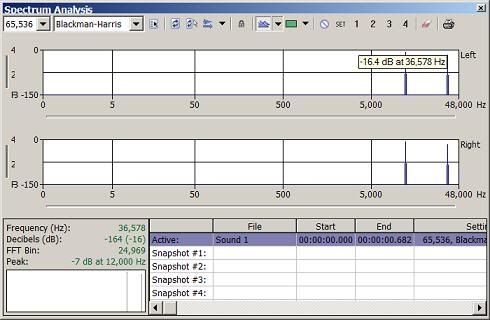 drewfx
post edited by drewfx1 - 2009/11/09 11:33:07
|
Freddie H
Max Output Level: -39 dBFS
- Total Posts : 3617
- Joined: 2007/09/21 06:07:40
- Status: offline
Re:96kHZ 32bit / 64bit bit size ROCK!! I will never switch back!!!
2009/11/09 11:34:36
(permalink)
bitflipper
If this 12kHz sine wave is switched to a square wave we all still can hear the difference between sine and square wave...THIS IS AMAZING.
That would be amazing, indeed. Unfortunately, it is also untrue.
How are you generating the 12KHz test tone? You'll need a laboratory signal generator to do that; no synthesizer I know of can even go half that high.
How are you playing the 12Khz test tone? A few speakers (Tannoys come to mind) advertise extended high-frequency response up to about 24KHz, but you'd need to be able to reproduce 36KHz just to get the lowest of the significant harmonic components.
?  Bit! Bit! Take a---> EQ-->add 12 kHz "done"---> now I have generator that generator that! Regards Freddie
-Highly developed spirits often encounter resistance from mediocre minds. -It really matters!
|
Freddie H
Max Output Level: -39 dBFS
- Total Posts : 3617
- Joined: 2007/09/21 06:07:40
- Status: offline
Re:96kHZ 32bit / 64bit bit size ROCK!! I will never switch back!!!
2009/11/09 11:40:42
(permalink)
I will come back later and post some info that I've found out.... It will be kind of long "Post" Conclusions --->Nothing is "Black and White" more grey scale.... every one here are right! 48 kHz vsounds very good and 96 sounds very good too... Best Regards Freddie
post edited by Freddie H - 2009/11/09 12:00:28
-Highly developed spirits often encounter resistance from mediocre minds. -It really matters!
|
Freddie H
Max Output Level: -39 dBFS
- Total Posts : 3617
- Joined: 2007/09/21 06:07:40
- Status: offline
Re:96kHZ 32bit / 64bit bit size ROCK!! I will never switch back!!!
2009/11/09 11:59:31
(permalink)
UnderTow
Muziekschuur at home
In the nineties the same was happening with consoles. It was about how many khz their preamps and mixingconsoles let through.
In the end SSL Neve and D&R (among others) created great consoles wich let through up to 100khz and sometimes up to 200khz.
This makes sense because having your -3 dB (or whatever) point at 100Khz or more means a very flat linear response in the audible band.
If you have a lowpass filter to cut down noise in a cd-player it damages some high frequencies because of the lack of steepness of analog filtering.
Non-sense. Only someone that doesn't understand modern converters would say such a thing. The ADC is oversampled and DAC is upsampled so the analogue filter does not have to be so steep. The oversampling can be anything up to 1024 the base rate.
44.1 was a wrongly chosen sampleformat created by Philips.
You can not say that without knowing why that sample rate was chosen. It was most probably an engineering decision and as most engineering decisions, a compromise between many factors. (Btw, the Beethoven 9th or 5th or whatever story is an urban myth).
When you record music with high frequency content (every bang on cymbals will give frequencies up to 50khz (and above but much more weakened). When recording at 44.1. khz. (every sample is half a wavefile so 44.1 can hold up a frequency response of up to 22,5 khz. We loose much of of the high frequency content when loosing those 50khz to 22.1 khz content. We allso loose the lower harmonics of that part of the signal.
In a properly designed system we only lose inaudible frequencies.
And by the way. We are sensitive to phase up to 200khz.
So, much of the localisation content of the signal is lost when recording at 44.1 and 48khz.
This is absolutely NOT true. Read one of my previous posts about timing/phase accuracy in digital audio. It goes way beyond what the human ear can detect even at 44.1 Khz.
This is what the managing director of D&R (Duco de Rijke) had to say about this subject (about analog consoles).
Taken from the D&R website.... I think it is pretty interesting:
--------------------------------------------------------------------------------------------------------------
Did YOU know why analog sounds better than digital?
D&R started long ago (1972) making mixing consoles equipped with tubes.
One of the nicest parts of these hot valves were that they sounded great.
The sound was pleasantly warm and overload was not an issue with over 300 volts on the power rails and a bandwidth of up to 100kHz.
I think he means pleasantly distorted. We moved on from tubes because they were not clean enough.
Then we experimented with transistors and could not get the same sound as we had with tubes.
No indeed, good transistor designs are much cleaner.
Imagine listening to a sine wave of 1kHz, this should be a nice pure round sound like a pure tone of an old Hammond organ. Then switch this 1kHz frequency to a square wave, now you are listening to a sine wave plus on top of it lots of odd harmonics such as 3rd, 5th, 7th and so on .
Actually you are listening to 1 kHz plus on top of this on a very low level frequency 3khz, 5kHz , 7kHz 11khz and so on. So the difference in perceived sound is quite clear to any listener, nothing mystical here.
Now switch the fundamental 1kHz sine wave to let’s say 12kHz. Again a pure very high frequency tone could be noticed.
But now the funny part of it. If this 12kHz sine wave is switched to a square wave we all still can hear the difference between sine and square wave.
This points to either a bad wave generator or the signal is going into a non-linear device causing inter-modulation distortion. EDIT: Or the signals were not level matched for the in-band frequencies. We can NOT hear the harmonics. If we can hear anything, we are hearing artefact within the audible bandwidth. Mr Neve has designed some great analogue equipment but his comments on digital audio make me wonder if he really understands how it all works. Even some of his remarks and conclusions about analogue equipment are very strange to say the least.
THIS IS AMAZING.
No. This is a flawed test.
If we all agree on this, it means that we can hear or at least notice signals beyond 20kHz.
Remember the first harmonic content above 12kHz is 24kHz , and then 36kHz and so on.
These generated frequencies above 20kHz (even in small amounts) prove that it is important to have an audio system that has a bandwidth well over 20kHz.
Again, no. This is a flawed test. Double blind tests with good wave generators have demonstrated that people can not hear the difference when you filter out stuff above 20 Khz.
It is absolutely a fact that a small lift in frequency response of audio equipment well above 20kHz could easily give you the impression of giving you more air or transparency.
Again if this happens, this is due to changes in the audible band. Probably a phase shift but possibly a saturating (thus non-linear) stage somewhere in the EQ or elsewhere in the signal path.
Can you imagine why most digital consoles today sound harsh and can not even touch the smoothness of well designed analog consoles. This is easy understandable now with frequency responses that sharply fall off at 20kHz. No information above 20kHz means no warm open sound.
This is complete non-sense. If digital consoles sound harsh (which is not true for the good ones) it has nothing to do with the limited bandwidth. On the contrary. It goes even further than that, I heard a story once by someone that was one of the first listeners of a new Neve console. He and the other listeners found it harsh and aggressive sounding. Mr Neve said he could fix that. At the next listening session everyone agreed that it sounded much better, much warmer. When asked what he had changed Mr Neve answered that he had added low-pass filters to every channel.
Imagine what a digital upper shelving high frequency control is doing when lifting those frequencies by 16dB just before they sharply fall off at 20kHz.
It depends of the design.
I think that digital technology has along way to go before it can even touch analog audio sound wise.
Only if you don't understand it and anyway, what are the alternatives as a storage medium? Tape? Tape is MUCH more coloured than even the cheapest Soundblaster sound card.
Here is the thread about this subject I started a year ago;
http://www.gearslutz.com/board/high-end/128405-hearing-above-20khz-analog-consoles.html
Cool. Will read. :)
More importantly. Bruell & Kjaer did create microphones in the nineties who could capture that high frequency content. Up to that point high frequencies could not be captured in that accuracy. (allthough tape machines record up to 50khz.
Bruell & Kjaer now has a brand called DPA microphones. When you hear those microphones (like the 4006 or the 4090) you soon realise that high frequencies add alot to a mix....
It could be that those microphones just sound different. Or maybe they are more linear in the audible range and what you hear is LESS artefacts from ultrasonic frequencies.
UnderTow
Hear Hear! Also true!
-Highly developed spirits often encounter resistance from mediocre minds. -It really matters!
|
Muziekschuur at home
Max Output Level: -62 dBFS

- Total Posts : 1442
- Joined: 2006/03/01 03:30:22
- Status: offline
Re:96kHZ 32bit / 64bit bit size ROCK!! I will never switch back!!!
2009/11/09 12:18:37
(permalink)
Hey Undertow,
Thanks for the comments.... A reall "other way" to look at the same things....
Lots of stuff to think about.
Appriciate it.
Muziekschuur
Cakewalk Sonar Platinum Windows 7 32bit & 64bit (dualboot) Gigabyte mobo Intel dual quad 9650 & 4GB Ram RME DIGI9636 & Tascam DM24. M-audio Rbus & SI-24 Alesis Pro active 5.1 & Radford 90 transmissionline monitors. Roland RD-150 piano Edirol UM-880 & alesis fireport. Remote recording Alesis HD-24 & Phonic MRS 1-20. P.A. D&R Dayner 29-8-2 & behringer MX8000 (& racks) Rackpc Sonar Platinum with win10 AMD X6 1055T, 16GB Ram Dell inspiron 17R 6gb ram W10 two SSD's Sonar Plat.
|
Muziekschuur at home
Max Output Level: -62 dBFS
- Total Posts : 1442
- Joined: 2006/03/01 03:30:22
- Status: offline
Re:96kHZ 32bit / 64bit bit size ROCK!! I will never switch back!!!
2009/11/09 12:41:59
(permalink)
When we use the 64bit mode in either Sonar64 or Sonar32bit we get a 64bit masterbus. When we use digital (convolution) reverb and add this to our recorded audio the extra bits up to 64 may be needed so the calculations of added reverb to the recorded 24bit audio is calculated with the best accuracy. And not rounded off when each piece of audio is hitting severall busses.
The TC Electronics system 6000 & Lexicon 960 are fixed point 40bit sharks at 96khz. Not sure why those reputable companies went that high when we all claim we can't hear above a 44.1 khz 24bit samplerate. When there are loads of threads stating those reverbs are tha bomb.
At least with the current Cakewalk technique we can match 40 bit fixed point with 64bit float. And match their samplerate....
Muziekschuur
Cakewalk Sonar Platinum Windows 7 32bit & 64bit (dualboot) Gigabyte mobo Intel dual quad 9650 & 4GB Ram RME DIGI9636 & Tascam DM24. M-audio Rbus & SI-24 Alesis Pro active 5.1 & Radford 90 transmissionline monitors. Roland RD-150 piano Edirol UM-880 & alesis fireport. Remote recording Alesis HD-24 & Phonic MRS 1-20. P.A. D&R Dayner 29-8-2 & behringer MX8000 (& racks) Rackpc Sonar Platinum with win10 AMD X6 1055T, 16GB Ram Dell inspiron 17R 6gb ram W10 two SSD's Sonar Plat.
|
brundlefly
Max Output Level: 0 dBFS

- Total Posts : 14250
- Joined: 2007/09/14 14:57:59
- Location: Manitou Spgs, Colorado
- Status: offline
Re:96kHZ 32bit / 64bit bit size ROCK!! I will never switch back!!!
2009/11/09 13:00:00
(permalink)
The TC Electronics system 6000 & Lexicon 960 are fixed point 40bit sharks at 96khz. Not sure why those reputable companies went that high when we all claim we can't hear above a 44.1 khz 24bit samplerate. For the same reason that Gillette and Schick both make quad-blade razors. Remember the SNL skit? "The Triple-Trac. Because... YOU'LL BELIEVE ANYTHING!".
SONAR Platinum x64, 2x MOTU 2408/PCIe-424 (24-bit, 48kHz) Win10, I7-6700K @ 4.0GHz, 24GB DDR4, 2TB HDD, 32GB SSD Cache, GeForce GTX 750Ti, 2x 24" 16:10 IPS Monitors
|
drewfx1
Max Output Level: -9.5 dBFS
- Total Posts : 6585
- Joined: 2008/08/04 16:19:11
- Status: offline
Re:96kHZ 32bit / 64bit bit size ROCK!! I will never switch back!!!
2009/11/09 13:46:43
(permalink)
Muziekschuur at home
The TC Electronics system 6000 & Lexicon 960 are fixed point 40bit sharks at 96khz. Not sure why those reputable companies went that high when we all claim we can't hear above a 44.1 khz 24bit samplerate. When there are loads of threads stating those reverbs are tha bomb.
Being able to hear above 20kHz is not the only possible reason for using higher sample rates. As was discussed here many, many pages ago, filter artifacts below 20kHz, aliasing (from non-linear processing), or, in this case, digital interfacing with other gear running at 96kHz are other possible reasons you might do this. And if those reverbs are still "tha bomb" when used for producing 16bit/44kHz CD's, it isn't because of anything they're doing above 22kHz. drewfx
|
batsbrew
Max Output Level: 0 dBFS
- Total Posts : 10037
- Joined: 2007/06/07 16:02:32
- Location: SL,UT
- Status: offline
Re:96kHZ 32bit / 64bit bit size ROCK!! I will never switch back!!!
2009/11/09 14:36:14
(permalink)
g0d d*mn, this thread has a sh!t load of yapping!!!!
LOL
|
Tom F
Max Output Level: -48 dBFS

- Total Posts : 2749
- Joined: 2007/07/08 05:56:12
- Location: Vienna (the one in Europe)
- Status: offline
Re:96kHZ 32bit / 64bit bit size ROCK!! I will never switch back!!!
2009/11/09 14:52:49
(permalink)
batsbrew
g0d d*mn, this thread has a sh!t load of yapping!!!!
LOL
it LOOKED like the discussion was ended - but - damn - its starting again - now with arguments lie "everything is like this AND like that" "everyone is right" and whatever.... hahahahah ...
...trying to be polite... quick temper...trying to be...
|
UnderTow
Max Output Level: -37 dBFS

- Total Posts : 3848
- Joined: 2004/01/06 12:13:49
- Status: offline
Re:96kHZ 32bit / 64bit bit size ROCK!! I will never switch back!!!
2009/11/09 15:00:51
(permalink)
Muziekschuur at home
When we use the 64bit mode in either Sonar64 or Sonar32bit we get a 64bit masterbus. When we use digital (convolution) reverb and add this to our recorded audio the extra bits up to 64 may be needed so the calculations of added reverb to the recorded 24bit audio is calculated with the best accuracy. And not rounded off when each piece of audio is hitting severall busses.
In an ideal situation all your plugins are VST 2.4 and support 64 bit in which case it isn't just the master bus that is 64 bit but the entire signal path from ADC or file playback to DAC or bounce/export. In most setups there will be a few 32 bit plugins somewhere in the signal path. Still, although that might not be ideal for processing depending on what is going on, it is certainly enough for relaying signals. In other words, a plugin might process internally at 64 bit but communicate with the host at 32 bit.
The TC Electronics system 6000 & Lexicon 960 are fixed point 40bit sharks at 96khz. Not sure why those reputable companies went that high when we all claim we can't hear above a 44.1 khz 24bit samplerate. When there are loads of threads stating those reverbs are tha bomb.
I am not a big fan of the 960 but the TC 6000 is absolutely great! The reason for higher bit depth for processing is clear: More precision. No one here (or elsewhere AFAIK) is disagreeing with that. As for the 96 khz sample rate, the brochure says that the internal sample rate can be selected from 44.1/48/88.2/96. I see no issue with that. Also something to remember is that the TC 6000 doesn't just do reverberation. It is also one of the best outboard digital dynamics processors available. Non-linear processes like dynamics processing can and does benefit from higher sampling rates. This minimizes aliasing which is not entirely avoidable when doing digital non-linear processing AFAIK.
At least with the current Cakewalk technique we can match 40 bit fixed point with 64bit float. And match their samplerate....
Sonar certainly can and many plugins can also but that isn't all it takes to make a great sounding product. :-) Here is a bit of a summary of some of the points made in this thread: - A distinction should be made between recording/playback sample rates and bit depths and processing/synthesis sample rates and bit depths.
- Many of the top designers and engineers propose 60-65 Khz as an ideal sampling rate for recording/playback. Unfortunately as that is not typically available, we chose 44.1/48 or 88.2/96 Khz depending on the destination format. (With current day SRC this is becoming even less of an issue). There is absolutely no scientific evidence warranting going beyond 96 Khz for recording or playback.
- With these sample rates, 44.1/48 88.2/96 Khz, the base sample rates of the converters are meant. The modulators etc can and usually do work at speeds which are multiples of the base rates. These are typical multiples: 64, 128, 256, 512, 1024. This is to ensure that the analogue anti-aliasing and anti-imaging filters have shallow curves and operate outside of the audible band.
- For playback purposes, 44.1 Khz 24 bit covers the full human frequency and dynamic range. It also more than covers the human timing/phase sensitivity. For most recorded and mixed music, 16 bit is more than sufficient as the loud signal more than drowns out anything at or below the noise floor.
- With the right high quality converters one would be very hard pressed to be able to distinguish between 44.1/48 Khz and 88.2/96 Khz. On older or cheaper deisgns the difference can be more or even much more noticable.
- For processing purposes it can make sense to use higher sampling rates but not always. Liner processing does not benefit from higher sampling rates. Non-linear processing benefits from higher sampling rates.
- Some people are advocates of working at 88.2/96 Khz until the final down-sample for CD. This is fine if you have the resources. Others advocate only up-sampling locally for the processing that benefits from it. Both approaches are valid.
- For processing purposes higher bit depths should yield more precision.
Everything in engineering is a compromise. As long as we have to deal with physical and financial realities, including the very real limitations of our hearing, a good engineer will chose the right set of trade-off's to provide the best solution at the best quality-price ratio. That does not always mean higher sample rates and/or bit-depth but it can. UnderTow
|
MatsonMusicBox
Max Output Level: -73 dBFS

- Total Posts : 879
- Joined: 2008/07/09 10:56:31
- Location: Hanover, PA
- Status: offline
Re:96kHZ 32bit / 64bit bit size ROCK!! I will never switch back!!!
2009/11/09 15:07:56
(permalink)
One other thing .....
Having done most of my work at 88.2/24 and a few (usually by accident) at 44.1/24, and FWIW, I can tell you that SONAR is MUCH better behaved for me at 44.1/24 - very few dropouts, glitches, corruption, etc. etc. etc. Whereas, 88.2 projects have been much more touchy. This is even though I'm running a Quad Core with 4G and even though my CPU hit rarely gets above half on any of the processors even at 88.2
|
Freddie H
Max Output Level: -39 dBFS
- Total Posts : 3617
- Joined: 2007/09/21 06:07:40
- Status: offline
Re:96kHZ 32bit / 64bit bit size ROCK!! I will never switch back!!!
2009/11/10 07:25:30
(permalink)
UnderTow
Muziekschuur at home
When we use the 64bit mode in either Sonar64 or Sonar32bit we get a 64bit masterbus. When we use digital (convolution) reverb and add this to our recorded audio the extra bits up to 64 may be needed so the calculations of added reverb to the recorded 24bit audio is calculated with the best accuracy. And not rounded off when each piece of audio is hitting severall busses.
In an ideal situation all your plugins are VST 2.4 and support 64 bit in which case it isn't just the master bus that is 64 bit but the entire signal path from ADC or file playback to DAC or bounce/export.
In most setups there will be a few 32 bit plugins somewhere in the signal path. Still, although that might not be ideal for processing depending on what is going on, it is certainly enough for relaying signals. In other words, a plugin might process internally at 64 bit but communicate with the host at 32 bit.
The TC Electronics system 6000 & Lexicon 960 are fixed point 40bit sharks at 96khz. Not sure why those reputable companies went that high when we all claim we can't hear above a 44.1 khz 24bit samplerate. When there are loads of threads stating those reverbs are tha bomb.
I am not a big fan of the 960 but the TC 6000 is absolutely great! The reason for higher bit depth for processing is clear: More precision. No one here (or elsewhere AFAIK) is disagreeing with that. As for the 96 khz sample rate, the brochure says that the internal sample rate can be selected from 44.1/48/88.2/96. I see no issue with that.
Also something to remember is that the TC 6000 doesn't just do reverberation. It is also one of the best outboard digital dynamics processors available. Non-linear processes like dynamics processing can and does benefit from higher sampling rates. This minimizes aliasing which is not entirely avoidable when doing digital non-linear processing AFAIK.
At least with the current Cakewalk technique we can match 40 bit fixed point with 64bit float. And match their samplerate....
Sonar certainly can and many plugins can also but that isn't all it takes to make a great sounding product. :-)
Here is a bit of a summary of some of the points made in this thread:
- A distinction should be made between recording/playback sample rates and bit depths and processing/synthesis sample rates and bit depths.
- Many of the top designers and engineers propose 60-65 Khz as an ideal sampling rate for recording/playback. Unfortunately as that is not typically available, we chose 44.1/48 or 88.2/96 Khz depending on the destination format. (With current day SRC this is becoming even less of an issue). There is absolutely no scientific evidence warranting going beyond 96 Khz for recording or playback.
- With these sample rates, 44.1/48 88.2/96 Khz, the base sample rates of the converters are meant. The modulators etc can and usually do work at speeds which are multiples of the base rates. These are typical multiples: 64, 128, 256, 512, 1024. This is to ensure that the analogue anti-aliasing and anti-imaging filters have shallow curves and operate outside of the audible band.
- For playback purposes, 44.1 Khz 24 bit covers the full human frequency and dynamic range. It also more than covers the human timing/phase sensitivity. For most recorded and mixed music, 16 bit is more than sufficient as the loud signal more than drowns out anything at or below the noise floor.
- With the right high quality converters one would be very hard pressed to be able to distinguish between 44.1/48 Khz and 88.2/96 Khz. On older or cheaper deisgns the difference can be more or even much more noticable.
- For processing purposes it can make sense to use higher sampling rates but not always. Liner processing does not benefit from higher sampling rates. Non-linear processing benefits from higher sampling rates.
- Some people are advocates of working at 88.2/96 Khz until the final down-sample for CD. This is fine if you have the resources. Others advocate only up-sampling locally for the processing that benefits from it. Both approaches are valid.
- For processing purposes higher bit depths should yield more precision.
Everything in engineering is a compromise. As long as we have to deal with physical and financial realities, including the very real limitations of our hearing, a good engineer will chose the right set of trade-off's to provide the best solution at the best quality-price ratio. That does not always mean higher sample rates and/or bit-depth but it can.
UnderTow
Great Post UnderTow! Agree, valid points!  Often things like softwares and higher sample rates have benefits, but everthing is about up-sampling. I will post later an longer POST about all this. I have discussed this with other producers /friends and I will share their comments and experiences about this, as soon as I can sit down and make a longer post... Have a nice day! Best Regards Freddie
post edited by Freddie H - 2009/11/10 07:26:54
-Highly developed spirits often encounter resistance from mediocre minds. -It really matters!
|
Muziekschuur at home
Max Output Level: -62 dBFS
- Total Posts : 1442
- Joined: 2006/03/01 03:30:22
- Status: offline
Re:96kHZ 32bit / 64bit bit size ROCK!! I will never switch back!!!
2009/11/10 11:30:43
(permalink)
Undertow,
I agree with your points. They all are valid. It's just.... I allways wanted a TC6000 and could not afford. Now with my next computer probably being a 4 or 6 core machine with more memory then I would ever need I can process that quality in my pc. So that large setup with outbox this and outbox that is getting less and less nessesary.
I love surround mixing. And for that purpose I like having mono or stereo signals with a clear signal so it will be easier to create a believeable soundstage. The higher samplerate helps. I do work at 48khz. And it is a big difference to 16bit44.1. I have done some projects at 96khz. It will be fun to stay there and just..... don't have to worry about this anymore ...... and have better... (for my purpose) recordings.
Cakewalk Sonar Platinum Windows 7 32bit & 64bit (dualboot) Gigabyte mobo Intel dual quad 9650 & 4GB Ram RME DIGI9636 & Tascam DM24. M-audio Rbus & SI-24 Alesis Pro active 5.1 & Radford 90 transmissionline monitors. Roland RD-150 piano Edirol UM-880 & alesis fireport. Remote recording Alesis HD-24 & Phonic MRS 1-20. P.A. D&R Dayner 29-8-2 & behringer MX8000 (& racks) Rackpc Sonar Platinum with win10 AMD X6 1055T, 16GB Ram Dell inspiron 17R 6gb ram W10 two SSD's Sonar Plat.
|
UnderTow
Max Output Level: -37 dBFS
- Total Posts : 3848
- Joined: 2004/01/06 12:13:49
- Status: offline
Re:96kHZ 32bit / 64bit bit size ROCK!! I will never switch back!!!
2009/11/10 13:46:31
(permalink)
Muziekschuur at home
Undertow,
I agree with your points. They all are valid. It's just.... I allways wanted a TC6000 and could not afford. Now with my next computer probably being a 4 or 6 core machine with more memory then I would ever need I can process that quality in my pc.
The quality of the processing has not been about the available processing power for quite a while. It is all about the talent and experience of the developers. TC has some very good people working for them. Some argue that there is no plugin that is as good as the TC6000 dynamics section. I haven't done enough tests to say whether this is true or not. UnderTow
|
Muziekschuur at home
Max Output Level: -62 dBFS
- Total Posts : 1442
- Joined: 2006/03/01 03:30:22
- Status: offline
Re:96kHZ 32bit / 64bit bit size ROCK!! I will never switch back!!!
2009/11/10 16:04:28
(permalink)
I'm happy with less at the compression front. As I have never touched the compression section I do not have an opinion on that. I have heard that the TC Card for pc's slowly is getting the goodies. I allready have a UAD1. So maybe I should get a TC card in my next pc..... with Sonar9 that is....
Cheers Undertow.
Cakewalk Sonar Platinum Windows 7 32bit & 64bit (dualboot) Gigabyte mobo Intel dual quad 9650 & 4GB Ram RME DIGI9636 & Tascam DM24. M-audio Rbus & SI-24 Alesis Pro active 5.1 & Radford 90 transmissionline monitors. Roland RD-150 piano Edirol UM-880 & alesis fireport. Remote recording Alesis HD-24 & Phonic MRS 1-20. P.A. D&R Dayner 29-8-2 & behringer MX8000 (& racks) Rackpc Sonar Platinum with win10 AMD X6 1055T, 16GB Ram Dell inspiron 17R 6gb ram W10 two SSD's Sonar Plat.
|
Muziekschuur at home
Max Output Level: -62 dBFS
- Total Posts : 1442
- Joined: 2006/03/01 03:30:22
- Status: offline
Re:96kHZ 32bit / 64bit bit size ROCK!! I will never switch back!!!
2009/11/11 10:55:10
(permalink)
Undertow,
Last remark. It was not long ago speaker designers had measuring devices wich did not go beond 20KHZ. If you tried to get graphics of drivers going beond 20KHZ. You could not get hold of such information.
The last few years (2000) when the high resolution hype was started (DVD-9 with DTS) manufacturers started to create tweeters with berrilium (material fast enough so dome tweeters could reproduce above 20khz) and ribbon tweeters. Those designs aren't around very long. So many tests in the past may or may not have been flawed by the speakers used for testing.....
(I did research this topic long and hard)..... I'm interested to hear your view.
Muziekschuur
Cakewalk Sonar Platinum Windows 7 32bit & 64bit (dualboot) Gigabyte mobo Intel dual quad 9650 & 4GB Ram RME DIGI9636 & Tascam DM24. M-audio Rbus & SI-24 Alesis Pro active 5.1 & Radford 90 transmissionline monitors. Roland RD-150 piano Edirol UM-880 & alesis fireport. Remote recording Alesis HD-24 & Phonic MRS 1-20. P.A. D&R Dayner 29-8-2 & behringer MX8000 (& racks) Rackpc Sonar Platinum with win10 AMD X6 1055T, 16GB Ram Dell inspiron 17R 6gb ram W10 two SSD's Sonar Plat.
|
Freddie H
Max Output Level: -39 dBFS
- Total Posts : 3617
- Joined: 2007/09/21 06:07:40
- Status: offline

Re:96kHZ 32bit / 64bit bit size ROCK!! I will never switch back!!!
2009/11/11 12:12:35
(permalink)
Does it sound better in 96kHz?
Yes & No, all depends, its many factor to consider!

The picture has nothing to do with me or the subject! It sound "different" compare to 48kHz due to software oversampling...but is it distortion I hear compare to the sound I hear in the 48kHz? It sound "different"! As many have already comment, its a possibility you get worse sound in 96kHz compare to 48kHz too. The main thing is is it worth the 3x more CPU usage in 96 kHz? 48kHz sounds perfect too. I can not complain over the 48 kHz sampling quality at all. All depends what the software has in internal sampling frequency too? Is the software in 44.1 kHz, 48kHz, 96kHz 32bit floating? If its in 48kHz default---> then it will benefit run in 48kHz. Is it in 48--> and then oversampling---> to 96kHz it can well loose its overall high quality it had instead... Friends have and share the same thoughts & comments. We all do in this thread. Some say that you can benefit internal working with software's & plugins “oversampling” in higher frequency like 96kHz. But you will hardly notice any big difference compare to 48Khz. Recording vocals and guitars and so on, hardly any benefits compare to 48 kHz 32bit floating... Reverb and FX can fit better in the mix in 96kHz VS 48kHz but if this to due to oversampling I don't know?
Conclusions! I was wrong; for now its not worth it---> 3x overall CPU usage in 96kHz! 48 kHz sounds great so I'm back with 48kHz for now. Perhaps in the future when we get even better CPU:s then the i7... then perhaps it worth it. I always work with huge projects +100 channels so even if my computer can manage 96kHz I want to have the overall “CPU-headroom” to work with. Today it barley reach more then 50 % in 48kHz projects in SONAR 8.5 x64bit. X64bit makes it all run even smoother and I have no limits of use of RAM-memory so that's great too. Also 48kHz sounds fantastic good and with data-bits of 32bit floating or higher; you have the guarantee that you will not loose any quality working with your software synths and your audio files “internal” in SONAR. The only thing I will not recommend anyone to use is 44.1 kHz, 16bit, but is another story and I think we all can agree on that... Best Regards Freddie
post edited by Freddie H - 2009/11/11 12:20:50
-Highly developed spirits often encounter resistance from mediocre minds. -It really matters!
|
UnderTow
Max Output Level: -37 dBFS
- Total Posts : 3848
- Joined: 2004/01/06 12:13:49
- Status: offline
Re:96kHZ 32bit / 64bit bit size ROCK!! I will never switch back!!!
2009/11/11 12:40:19
(permalink)
Muziekschuur at home
Undertow,
Last remark. It was not long ago speaker designers had measuring devices wich did not go beond 20KHZ. If you tried to get graphics of drivers going beond 20KHZ. You could not get hold of such information.
Or they just didn't measure above 20 Khz because it is irrelevant to human hearing. There have been devices that can measure above 20 Khz for a very long time. At least since the 1930's and probably before. The last few years (2000) when the high resolution hype was started (DVD-9 with DTS) manufacturers started to create tweeters with berrilium (material fast enough so dome tweeters could reproduce above 20khz) and ribbon tweeters. Those designs aren't around very long. So many tests in the past may or may not have been flawed by the speakers used for testing.....
To me this is all marketing non-sense When a company produces a speaker with a super tweeter it tells me one of two things: 1) They don't know enough about human hearing 2) The marketing department has too much power. So much so that marketing considerations trump good solid engineering. Either of these is enough to not want me have anything to do with the company. I lost alot of faith in Tannoy when they started making speakers with super-tweeters. They had a good thing going with their "point source" approach. Their concentric driver design made alot of sense. Then they went and added a separate super tweeter. Right. Bye bye. My previous set of speakers had a response that was more or less flat to about 40Khz. My new set of speakers are flat to 20Khz and then drop down to -6 dB by 23 Khz because they have a low-pass filter on the tweeter! The manufacturer of these speakers know that you don't want stuff above 20Khz because it is likely to be junk more than anything else and it can damage your tweeters. Now guess which pair has a more detailed, clear and natural sounding high-end? UnderTow
|
Fret Wizz
Max Output Level: -79 dBFS

- Total Posts : 581
- Joined: 2007/07/01 13:46:57
- Location: Adelaide South Australia
- Status: offline
Re:96kHZ 32bit / 64bit bit size ROCK!! I will never switch back!!!
2009/11/11 23:57:28
(permalink)
Freddie H
FLac! I think that will soon change too. They will be start streaming in higher format, spotify!
Flac is a great format. And not encumbered by any royalty payments etc etc I have an iRiver media player that plays flac files natively.
Fret Wizz SONAR 8.5 PE 64 bit : Win 7 Ultimate 64 Bit : Echo MIA
|
Freddie H
Max Output Level: -39 dBFS
- Total Posts : 3617
- Joined: 2007/09/21 06:07:40
- Status: offline
Re:96kHZ 32bit / 64bit bit size ROCK!! I will never switch back!!!
2009/11/13 15:09:35
(permalink)
Fret Wizz
Freddie H
FLac! I think that will soon change too. They will be start streaming in higher format, spotify!
Flac is a great format.
And not encumbered by any royalty payments etc etc
I have an iRiver media player that plays flac files natively.
Yes Its great! Have a nice weekend! Regards Freddie
-Highly developed spirits often encounter resistance from mediocre minds. -It really matters!
|
Freddie H
Max Output Level: -39 dBFS
- Total Posts : 3617
- Joined: 2007/09/21 06:07:40
- Status: offline

Re:96kHZ 32bit / 64bit bit size ROCK!! I will never switch back!!!
2009/11/13 18:30:39
(permalink)
Please, I have sincer question! 44.1 kHz VS 48 kHZ?
Can we hear he different in the softwares? I have problem with my Kontakt in 48kHz and up so it seems that I get unfortunately forced to work and use 44.1 kHz again instead...  At least until this get fixed! I feel it doesn't sound as good as 48 kHz though, but I want to hear any good thoughts & comments about this? http://forum.cakewalk.com/tm.aspx?m=1854900 I do listen on what you all have to say, you all know that! Best Regards Freddie
post edited by Freddie H - 2009/11/13 18:33:51
-Highly developed spirits often encounter resistance from mediocre minds. -It really matters!
|
John
Forum Host

- Total Posts : 30467
- Joined: 2003/11/06 11:53:17
- Status: offline
Re:96kHZ 32bit / 64bit bit size ROCK!! I will never switch back!!!
2009/11/13 18:38:27
(permalink)
From my point of view the difference is so tiny that even if it were somehow noticeable it would be a very small difference. I stay at 44.1 for ease of use and convenience. I am not sure why 48 was chosen in the first place. To me its just unnecessary complication.
|
Dude
Max Output Level: -81 dBFS

- Total Posts : 458
- Joined: 2003/11/14 18:32:25
- Location: San Francisco
- Status: offline
Re:96kHZ 32bit / 64bit bit size ROCK!! I will never switch back!!!
2009/11/13 18:57:38
(permalink)
Well ... it's used in miniDV, digital TV, DVD, Digital Audio Tape.
I believe the original reason was to get enough headroom for simple filters to operate without introducing audible artifacts (read: aliasing). Of course good filters have now come down in price and is not as much of an issue as it was originaly in digital video products.
Dude
Interface: TC Konnekt 24D PC: Intel P4 2.8C/ASUS P4C800-E/Matrox G550/1GB RAM/XP SP2 Laptop: ThinkPad T41/TI Firewire PCMCIA Card/1GB RAM/XP SP2 DAW: Sonar 8
|
Freddie H
Max Output Level: -39 dBFS
- Total Posts : 3617
- Joined: 2007/09/21 06:07:40
- Status: offline
Re:96kHZ 32bit / 64bit bit size ROCK!! I will never switch back!!!
2009/11/13 19:08:59
(permalink)
Okay! =)
Thanks John and Dude! Have a nice weekend!
Best Regards
Freddie
-Highly developed spirits often encounter resistance from mediocre minds. -It really matters!
|
John
Forum Host
- Total Posts : 30467
- Joined: 2003/11/06 11:53:17
- Status: offline
Re:96kHZ 32bit / 64bit bit size ROCK!! I will never switch back!!!
2009/11/13 19:47:01
(permalink)
Well ... it's used in miniDV, digital TV, DVD, Digital Audio Tape. I believe the original reason was to get enough headroom for simple filters to operate without introducing audible artifacts (read: aliasing). Of course good filters have now come down in price and is not as much of an issue as it was originaly in digital video products. Dude I know where its used what I don't get is why. CD were out way before DVD or any other video format for disks. I just suspect it is another "we decided to do it this way for incompatibility reasons". The CD format was not developed in Japan thus when DVD was being speced out here was a way to make it different for difference sake. The 24 bit part was good the 48 kHz sample rate seems arbitrary.
|
Freddie H
Max Output Level: -39 dBFS
- Total Posts : 3617
- Joined: 2007/09/21 06:07:40
- Status: offline
Re:96kHZ 32bit / 64bit bit size ROCK!! I will never switch back!!!
2009/11/13 20:45:51
(permalink)
I don't know but to me it sounds little more dynamic-sounding in 48 kHz 32bit, especially if you adding EQ:s and other filters...
I will probably continue working in 48 kHz 32bit even though of the Kontakt bug!
Regards
Freddie
-Highly developed spirits often encounter resistance from mediocre minds. -It really matters!
|
Jose7822
Max Output Level: 0 dBFS
- Total Posts : 10031
- Joined: 2005/11/07 18:59:54
- Location: United States
- Status: offline
Re:96kHZ 32bit / 64bit bit size ROCK!! I will never switch back!!!
2009/11/13 22:18:43
(permalink)
Freddie,
I can understand you wanting to record at 192KHz more than I can compehend why you would record in 32 bit. At least the former gives you more data (even if you can't hear it), but the latter doesn't. It just makes the files bigger for no reason. Converters can only go up to 24 bits. Setting them to record at 32 bit fills the file with silence by padding 0's at the end. There's no audio quality gain and you're only giving your computer a hard time. It's a lost case my friend :-)
HTH
Intel Q9400 2.66 GHz 8 GB of RAM @ 800 Mhz ATI Radeon HD 3650 Windows 7 Professional (SP1) x64 Cubase 6.03 x64 Sonar PE 8.5.3 x64 RME FireFace 400 Frontier Design Alpha Track Studio Logic VMK-188 Plus http://www.youtube.com/user/SonarHD
|
yorolpal
Max Output Level: 0 dBFS
- Total Posts : 13829
- Joined: 2003/11/20 11:50:37
- Status: offline
Re:96kHZ 32bit / 64bit bit size ROCK!! I will never switch back!!!
2009/11/13 22:41:41
(permalink)
Me thinks our good friend Freddie actually prefers more...er...nothing in his recordings.
|