musicroom
Max Output Level: -51 dBFS

- Total Posts : 2421
- Joined: 2004/04/26 22:31:02
- Status: offline

Re: The meters are not accutate!
2016/02/17 18:03:53
(permalink)
Bristol_Jonesey
Your starting fader positions will also vary depending on the total number of tracks in your project.
As a rough rule of thumb, the formula is (in Excel) -20 x Log(total number of tracks)
So as an example, for a 15 track project, initial fader positions should be around (on average!) -23.5dB
This thread is good reading with helpful reminders to keep my old habits from creeping back in and stealing clarity from my mixes. !! And yes Bristol, I created an excel sheet with the formula you posted. Thank you to all who are taking the time to dig into this topic!
Dave Songs___________________________________ Desktop: Platinum / RME Multiface II / Purrfect Audio DAW I7-3770 / 16 GB RAM / Win 10 Pro / Remote Laptop i7 6500U / 12GB RAM / RME Babyface
|
Kristianzhe
Max Output Level: -90 dBFS

- Total Posts : 34
- Joined: 2015/09/23 16:26:13
- Status: offline
Re: The meters are not accutate!
2016/02/17 22:26:30
(permalink)
I do sometimes, or very often put a mastering limiter on the mixing bus, before taking it to mastering session. But that is only because I want the levels to be on spot. I always bounce out my tracks at -6 to -10 db in the mix, so hard to tell how the mastering chain then will react to all the sounds and glues. So, I use it as a level adjuster. For sure taking it back off when bouncing out the mix. For the workflow it is better for me, so I do not have to bounce out several mixes just to level the bass or something else. Back to the thread. I have never heard of people who bounce out a mix with a headroom of -0.1. without any compressor or limiter, they are doomed to get clipping in the mix. Compressors and limiters on the mixbus is a no go. The mastering engineer (or if you do it yourself) always ask and need no compressor or limiter on the master bus. Headroom is the essence for the mastering stage. Working with a -0,1 headroom is a nightmare. You also said you want the mix to be as high as possible. Why? You will get that after the mastering stage if done properly. Maybe I did misunderstand, but you aren`t going to upload the mix to any streaming services? If someone send a -0.1 mix to a professional mastering engineer I am sure he or she will get back to the person and ask for a lower mix. The lower the mix are, the better for the mastering session. So as John said in the first reply "Lower the volume" . It is not only obvious, it is also a solution. Nothing wrong with the Sonar Meters in my experience. Good luck with whatever solution you end up with 
post edited by Kristianzhe - 2016/02/17 22:45:15
|
drewfx1
Max Output Level: -9.5 dBFS

- Total Posts : 6585
- Joined: 2008/08/04 16:19:11
- Status: offline
Re: The meters are not accutate!
2016/02/17 23:41:45
(permalink)
sharke
This is a very interesting and informative article on levels and gain staging, and I would highly recommend that you read it.
https://www.soundonsound.com/sos/sep13/articles/level-headed.htm
Of interest:
.
.
.
In practice, many people, including me, believe that the summing engines in different DAWs don't always produce the same results when summing lots of very high-level signals, and that these differences can be audible. The probable reason for this, to put it simply, is down to differences in how the 32- or 64-bit floating-point calculations are rounded to create the 24-bit audio part of the floating-point data.
If we're talking about Sonar, the "many people, including me, believe that the summing engines in different DAWs don't always produce the same results when summing lots of very high-level signals, and that these differences can be audible" are quite wrong. It's complete and utter nonsense and easily proven so. The probable reason for this, to put it simply, is that the people who believe this stuff haven't a clue how the math works regarding digital audio. Having said that, there's absolutely no reason to try to mix to within a fraction a dB of 0dBFS. If you aim lower, there's less chance of messing things up for no reason, and it's just a matter of turning up the listening volume a little now and adjusting the gain for the output format during mastering.
 In order, then, to discover the limit of deepest tones, it is necessary not only to produce very violent agitations in the air but to give these the form of simple pendular vibrations. - Hermann von Helmholtz, predicting the role of the electric bassist in 1877.
|
sharke
Max Output Level: 0 dBFS

- Total Posts : 13933
- Joined: 2012/08/03 00:13:00
- Location: NYC
- Status: offline
Re: The meters are not accutate!
2016/02/18 01:13:39
(permalink)
drewfx1
The probable reason for this, to put it simply, is that the people who believe this stuff haven't a clue how the math works regarding digital audio.
That's fair enough. Count me in as one of those people who don't understand the math and tend to believe people who sound like they do. LOL! On the subject of people who sound like they know what they're talking about, The following epic Gearslutz thread is worth a read not just for the back and forth on the subject of levels and summing and clipping and whatnot, but also for some extremely interesting posts from SSL/Sony Oxford veteran Paul Frindle. https://www.gearslutz.com/board/so-much-gear-so-little-time/463010-reason-most-itb-mixes-dona-t-sound-good-analog-mixes-restored.html I was especially intrigued by this post: https://www.gearslutz.com/board/5063007-post76.html However - harking back to the headroom issue (or lack of it in digital), rolling of LF increases the signal peak level most of the time - because it changes the wave shape (by differentiation)! Changing waveforms can create larger peak levels - even if you have done so by 'losing something'! So doing this on a digital system with everything flat out - and avoiding overs - will actually reduce the level and presence of the instruments involved, and even the whole mix, if you're aiming at high volumes and modulation!
......................................
However to maintain the impact of this and avoid overs and clipping you will need to lower the levels throughout your mix to accommodate the extra peak level - and make sure your final mix maximiser/limiter 'does the right thing' in pushing the density and gain of the program without simply clipping off your tightened sound and turning it back into mush again.. The work I have been doing has been heavily involved in preserving these subtle effects - if they are actually still there in the program, while remaining compatible with current loudness trends - and the search for improvement goes on still..
So yet again operating at lower peak levels - and knowing what you are doing when mixing, rather than leaving it to little-understood side effects of your gear - can indeed give you a fantastic advantage and save you a fortune :-)
Some time ago I noticed that simply engaging the HPF of the Quadcurve EQ was sometimes enough to "overheat" a ProChannel signal (i.e. whereas before the ProChannel clipping light was not showing red at any point during playback, engaging the HPF would make it glow red in a few places). I know there has been a lot of talk in the past about what those ProChannel clip lights actually mean in reality, but what this did make me realize that as Frindle says, rolling off the lows with a filter can actually increase the peak level even though you're losing frequencies. I always found that interesting.
post edited by sharke - 2016/02/18 01:31:53
JamesWindows 10, Sonar SPlat (64-bit), Intel i7-4930K, 32GB RAM, RME Babyface, AKAI MPK Mini, Roland A-800 Pro, Focusrite VRM Box, Komplete 10 Ultimate, 2012 American Telecaster!
|
Kylotan
Max Output Level: -71 dBFS

- Total Posts : 995
- Joined: 2007/09/10 17:27:35
- Location: Nottingham, UK
- Status: offline
Re: The meters are not accutate!
2016/02/18 05:48:11
(permalink)
drewfx1
If we're talking about Sonar, the "many people, including me, believe that the summing engines in different DAWs don't always produce the same results when summing lots of very high-level signals, and that these differences can be audible" are quite wrong. It's complete and utter nonsense and easily proven so.
The probable reason for this, to put it simply, is that the people who believe this stuff haven't a clue how the math works regarding digital audio. I stopped buying Sound on Sound magazine when I saw one too many of these articles where someone 'believed' they could hear a difference between 2 pieces of gear or two approaches but could not or would not actually measure it.
Sonar Platinum (Newburyport) / Win 8.1 64bit / Focusrite Scarlett 6i6 / Absynth / Kontakt / Play / Superior Drummer 2 / ESP LTD guitar / etc Twilight's Embrace - gothic/death metal | Other works - instrumental/soundtracks
|
jshep0102
Max Output Level: -71 dBFS
- Total Posts : 984
- Joined: 2006/02/21 22:44:35
- Status: offline
Re: The meters are not accutate!
2016/02/18 08:53:32
(permalink)
From Steven's Slate Audiophiles fb page - Steven Slate Channels going into the red is fine because they won't digitally clip because it's a floating point mixer. The only thing that cannot clip is the final master since it's gotta go cleanly out the D/A's. So in my estimation - he's saying busses can clip, too. CLA levels from the Audio Legends course - 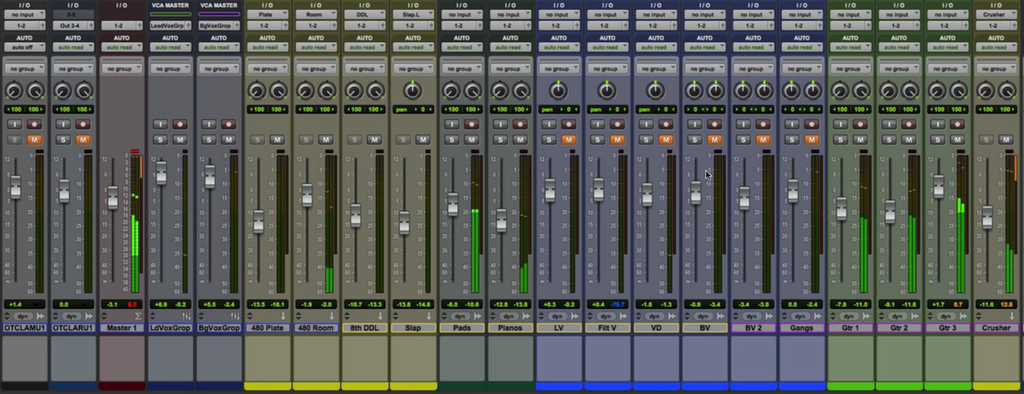
SHEP-ASRock Z97 Pro4 - i7 4790K 4.0ghz - 16 GB DDR3 - Windows 10 Home - Apollo Twin USB Duo - UAD2 Duo - Digimax FS - Focal CMS50 - Raven MTi2 - Slate VMS 1 - Bluebird - Yamaha MOXF8 - Axe Fx Ultra - SPLAT 2017.2
|
Anderton
Max Output Level: 0 dBFS
- Total Posts : 14070
- Joined: 2003/11/06 14:02:03
- Status: offline
Re: The meters are not accutate!
2016/02/18 08:58:51
(permalink)
Regarding the summing bus controversy, what complicates matters is that people may ascribe the wrong cause for an effect. The math of a summing engine should be indisputable, it's just math. It doesn't care whether it's adding big numbers or little numbers. However, think about what comes afterward. There can be non-linearities in converters and/or inter-sample distortion, which would come into play only when summing high-level signals. So someone concludes the issue is summing high-level signals when it has nothing to do with the summing bus.
|
jshep0102
Max Output Level: -71 dBFS
- Total Posts : 984
- Joined: 2006/02/21 22:44:35
- Status: offline
Re: The meters are not accutate!
2016/02/18 09:11:17
(permalink)
Absolutely, Craig. The SSL X-ISM for the final say so in these matters!
SHEP-ASRock Z97 Pro4 - i7 4790K 4.0ghz - 16 GB DDR3 - Windows 10 Home - Apollo Twin USB Duo - UAD2 Duo - Digimax FS - Focal CMS50 - Raven MTi2 - Slate VMS 1 - Bluebird - Yamaha MOXF8 - Axe Fx Ultra - SPLAT 2017.2
|
John T
Max Output Level: -7.5 dBFS

- Total Posts : 6783
- Joined: 2006/06/12 10:24:39
- Status: offline
Re: The meters are not accutate!
2016/02/18 09:22:33
(permalink)
sharke
Some time ago I noticed that simply engaging the HPF of the Quadcurve EQ was sometimes enough to "overheat" a ProChannel signal (i.e. whereas before the ProChannel clipping light was not showing red at any point during playback, engaging the HPF would make it glow red in a few places). I know there has been a lot of talk in the past about what those ProChannel clip lights actually mean in reality, but what this did make me realize that as Frindle says, rolling off the lows with a filter can actually increase the peak level even though you're losing frequencies. I always found that interesting.
That's a normal property of a low or high pass filter. Basically, the neat shapes you see in the graph are a bit of a lie, really. There's always some sort of resonant boost around the cut-off frequency.
http://johntatlockaudio.com/Self-build PC // 16GB RAM // i7 3770k @ 3.5 Ghz // Nofan 0dB cooler // ASUS P8-Z77 V Pro motherboard // Intel x-25m SSD System Drive // Seagate RAID Array Audio Drive // Windows 10 64 bit // Sonar Platinum (64 bit) // Sonar VS-700 // M-Audio Keystation Pro 88 // KRK RP-6 Monitors // and a bunch of other stuff
|
fret_man
Max Output Level: -84 dBFS

- Total Posts : 312
- Joined: 2009/05/14 23:57:37
- Status: offline
Re: The meters are not accutate!
2016/02/18 12:54:47
(permalink)
☄ Helpfulby John T 2016/02/19 20:35:46
Sorry, John. There are lots of filters with no resonant boosts. The most basic filter, Butterworth, is specifically designed for no resonance. However, the time-domain waveform can certainly have a larger peak-peak swing after going through a Butterworth filter. It is not always obvious to relate what's going on in the time-domain by mucking with it in the frequency domain.
|
drewfx1
Max Output Level: -9.5 dBFS
- Total Posts : 6585
- Joined: 2008/08/04 16:19:11
- Status: offline
Re: The meters are not accutate!
2016/02/18 13:39:22
(permalink)
☄ Helpfulby John T 2016/02/19 20:36:03
sharke
Some time ago I noticed that simply engaging the HPF of the Quadcurve EQ was sometimes enough to "overheat" a ProChannel signal (i.e. whereas before the ProChannel clipping light was not showing red at any point during playback, engaging the HPF would make it glow red in a few places). I know there has been a lot of talk in the past about what those ProChannel clip lights actually mean in reality, but what this did make me realize that as Frindle says, rolling off the lows with a filter can actually increase the peak level even though you're losing frequencies. I always found that interesting.
Any time you engage an EQ there is phase shift involved, which can cause a change in peaks. Sometimes it's not really helpful to get too caught up in the often complicated technical details. It can be very difficult or almost impossible to simplify technical things too much without saying something misleading or inaccurate. And if someone makes an even remotely questionable technical claim it invites a response even if it's not particularly relevant to the discussion at hand. If I remember correctly, Frindle got himself in trouble in that thread by making some technical arguments that weren't really in any way germane to the point he was trying to make, but invited a long technical debate nevertheless.
In order, then, to discover the limit of deepest tones, it is necessary not only to produce very violent agitations in the air but to give these the form of simple pendular vibrations. - Hermann von Helmholtz, predicting the role of the electric bassist in 1877.
|
Sanderxpander
Max Output Level: -36.5 dBFS

- Total Posts : 3873
- Joined: 2013/09/30 10:08:24
- Status: offline
Re: The meters are not accutate!
2016/02/18 19:13:31
(permalink)
☄ Helpfulby John T 2016/02/19 20:29:03
John T
sharke
Some time ago I noticed that simply engaging the HPF of the Quadcurve EQ was sometimes enough to "overheat" a ProChannel signal (i.e. whereas before the ProChannel clipping light was not showing red at any point during playback, engaging the HPF would make it glow red in a few places). I know there has been a lot of talk in the past about what those ProChannel clip lights actually mean in reality, but what this did make me realize that as Frindle says, rolling off the lows with a filter can actually increase the peak level even though you're losing frequencies. I always found that interesting.
That's a normal property of a low or high pass filter. Basically, the neat shapes you see in the graph are a bit of a lie, really. There's always some sort of resonant boost around the cut-off frequency.
Has nothing to do with any resonance. Simply speaking, the low frequency oscillation you're cutting has a positive and negative side on the amplitude graph. It could be that it is actually inhibiting a peak on the positive side because it is itself peaking or near peaking on the negative side. This is true even for non-resonant linear phase filters. It doesn't go just for low frequencies but a HPF often cuts a significant amount of a high energy frequency area so it's relatively common there. Another reason not to send files off to mastering at near 0dBFS.
|
John T
Max Output Level: -7.5 dBFS
- Total Posts : 6783
- Joined: 2006/06/12 10:24:39
- Status: offline
Re: The meters are not accutate!
2016/02/19 20:18:09
(permalink)
Ah, interesting. I've clearly misunderstood something somewhere.
This may appal the more technically-minded, of course, but I'm happy that my rule of thumb of "cuts in a filter may cause increases in level" was basically right, even if I was wrong about why. It all comes back to the larger point in the discussion which is "stop mixing close to 0db and a lot of these issues just go away".
http://johntatlockaudio.com/Self-build PC // 16GB RAM // i7 3770k @ 3.5 Ghz // Nofan 0dB cooler // ASUS P8-Z77 V Pro motherboard // Intel x-25m SSD System Drive // Seagate RAID Array Audio Drive // Windows 10 64 bit // Sonar Platinum (64 bit) // Sonar VS-700 // M-Audio Keystation Pro 88 // KRK RP-6 Monitors // and a bunch of other stuff
|
rabeach
Max Output Level: -48 dBFS

- Total Posts : 2703
- Joined: 2004/01/26 14:56:13
- Status: offline
Re: The meters are not accutate!
2016/02/20 16:36:32
(permalink)
No one can design a digital meter to truly interpret a DAC's response to saturation without feedback from the DAC. But anyone can design a meter to measure the grouping of saturated samples and market it as a tool. Inter-sample peaks seem to get a bad rap on the web. DACs are designed to minimize saturation effects. The result of this design is currently being referred to on the web as inter-sample peaks. It is not a bad thing it is a good thing. Not sure why on the web two saturated samples are referred to as distortion. It would only become distortion e.g. DC with a grouping of saturated samples that exceeded the DAC's design specification to minimize saturation effect. That aside imho there is very little to gain in saturating a DAC. A design engineer would assume that if you intentionally saturated a DAC your intent was to do so in order to make use of the saturation effect. If it is used as a tool for you to reach some end then that is what it is. When you speaker coils glow red you have gone to far.
post edited by rabeach - 2016/02/20 20:13:10
|
rabeach
Max Output Level: -48 dBFS
- Total Posts : 2703
- Joined: 2004/01/26 14:56:13
- Status: offline
Re: The meters are not accutate!
2016/02/20 17:30:59
(permalink)
If you are saturating a DAC within the guidelines of the DAC's specification to minimize saturation effect then for all intents and purposes your objective is to deviate from optimal reconstruction for the sake of SPL. Under this scenario imho it would be an available tool if that is your goal and you can control the saturation to remain within the DAC's established boundaries. afik at this point in time this would require a significant amount of work on the part of the person attempting to accomplish this.
post edited by rabeach - 2016/02/20 18:04:33
|
jpetersen
Max Output Level: -61 dBFS

- Total Posts : 1499
- Joined: 2015/07/11 20:22:53
- Status: offline
Re: The meters are not accutate!
2016/02/20 17:41:38
(permalink)
Freeze all your tracks (the snowflake * symbol). Now try again. Do the peaks still clip in a different way depending on where you start?
post edited by jpetersen - 2016/02/21 11:32:05
|
jpetersen
Max Output Level: -61 dBFS
- Total Posts : 1499
- Joined: 2015/07/11 20:22:53
- Status: offline
Re: The meters are not accutate!
2016/02/20 17:54:05
(permalink)
...oh, and for the test, also turn off the FX bins in any busses you might have.
|