Freddie H
Max Output Level: -39 dBFS

- Total Posts : 3617
- Joined: 2007/09/21 06:07:40
- Status: offline

Re:96kHZ 32bit / 64bit bit size ROCK!! I will never switch back!!!
2009/11/05 12:00:26
(permalink)
-Highly developed spirits often encounter resistance from mediocre minds. -It really matters!
|
John
Forum Host

- Total Posts : 30467
- Joined: 2003/11/06 11:53:17
- Status: offline
Re:96kHZ 32bit / 64bit bit size ROCK!! I will never switch back!!!
2009/11/05 12:14:54
(permalink)
rhythminmind
I like to mix it inside SONAR, do all my mixes there. Sometimes I'm work in other studios, with hardware controls, kind of nice. I use only O2R:s as like a patchbay so often the 02R:s are just shut off, route all my MAIN-audio from SONAR--> directly to my main outputs “1-2” of my E-mu 1616m. I'm a geek of hearing the best possible audio quality, so I don't even consider to insert Makie, big nobs or any other volume controls that degrade my perfect sound quality from my great A/D converters. Only thing I'm consider and are interesting in is the V-Studio 700, but hope I get it soon for free, kind of sponsor deal from Cakewalk... You can always wish Santa brings it around for Christmas, right! 
Are you running the o2rs in 24bit mode? It's not by default. If your not using a analog vol/monitoring control what are you controlling your monitoring level with?
There is something embedded in the quote of this that is disturbing. "so I don't even consider to insert Makie, big nobs or any other volume controls that degrade my perfect sound quality" I think the person that wrote that doesn't understand how a control surface works. The audio is not streamed to the CS in any way. A CS uses MIDI to interact with Sonar and manipulate the various controls of the program as if one is using a mouse to do the same thing. There is no degrading of the audio in any way because the audio is never sent to the CS. There is no good reason not to use a CS if one wishes to. Jose I use your post because I could not find the original post for who ever wrote the above. Another good reason to despise this forum software. No in response to indication what so ever.
|
AndyW
Max Output Level: -45.5 dBFS

- Total Posts : 2956
- Joined: 2005/10/06 17:13:00
- Status: offline
Re:96kHZ 32bit / 64bit bit size ROCK!! I will never switch back!!!
2009/11/05 12:39:35
(permalink)
dmmi
I understand mathematics very well
Based on what you wrote after this statement in your post...no, you don't. NyQuist-Shannon is both proven mathematically and *empirically* for over 70 years(not just audio but radio as well). It is why stuff *works*. I appreciate your desire to defend yourself(I am the same way), but you are 100% wrong in this discussion regarding the validity of the NyQuist-Shannon theorem and its application to sampling analog signals in the digital realm. It is this simple...NyQuist *proves*(not just suggests) that if your analog signal is bandlimited at X Hz, then a sampling rate of 2X Hz or greater is sufficient to *completely* reproduce the original signal in the analog domain when converted back to analog. Granted, there are some caveats, but they are not relevant to the core discussion here. I would encourage you to read the links on the Nyquist theorem again.
|
Susan G
Max Output Level: 0 dBFS

- Total Posts : 12016
- Joined: 2003/11/05 22:49:26
- Location: Putnam County, NY
- Status: offline
Re:96kHZ 32bit / 64bit bit size ROCK!! I will never switch back!!!
2009/11/05 12:46:20
(permalink)
Hi John- Another good reason to despise this forum software. No in response to indication what so ever. If I had to nominate my biggest complaint about the new software, this would definitely be on my short list! Heaven forbid you come late to a conversation; unless everyone fully quotes (or attributes the quote, neither of which were necessary previously) there's no context. The Thread Reading "Tree" Mode option is worthless, too, IMO. Personally, I much preferred seeing "In Reply to" instead of wading through multiple levels of indents, esp. since it's clear that some of us haven't yet mastered "The Art of the Indent"! Anyway... carry on...! -Susan
2.30 gigahertz Intel Core i7-3610QM; 16 GB RAMWindows 10 x64; NI Komplete Audio 6.SONAR Platinum (Lexington) x64
|
drewfx1
Max Output Level: -9.5 dBFS

- Total Posts : 6585
- Joined: 2008/08/04 16:19:11
- Status: offline
Re:96kHZ 32bit / 64bit bit size ROCK!! I will never switch back!!!
2009/11/05 12:48:47
(permalink)
OK, another way of understanding that a given SR contains all of the information up to the Nyquist frequency, including all of the information between the samples. As has been said many times, there is only 1 single curve that can be drawn between 2 sample points that doesn't contain frequencies above Nyquist. All of the other lines/curves will contain higher frequencies. To see why, consider that higher frequencies = sharper curves. A low frequency sin wave has very gentle, slowly changing curves. At high frequencies, the curve is sharp and rapidly changes. Any sharp curves (or corners) in a complex waveform equals high frequency content. This applies not just to pure sin waves, but any waveform. Here are 2 channels of white noise I created in SoundForge. Both are normalized to 0dB. The only difference is the bottom signal, which started out as a copy of the top one, is processed with a 5kHz low pass filter: 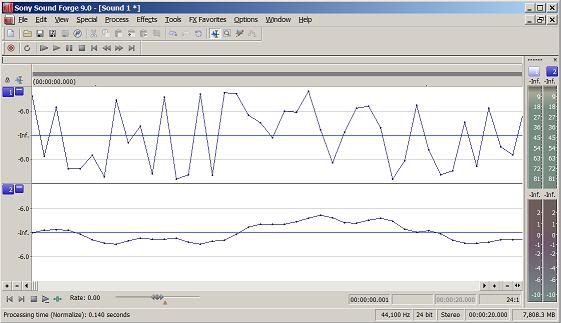 Notice that all of the changes are much smoother and gentler when the higher frequencies are removed. Now consider drawing a curve between 2 sample points: If we make the curve gentler near point A, we will need to make the curve sharper near point B. But making the curve sharper adds higher frequencies. Obviously, if we make the curve gentler near B, it will need to be sharper near A. This is why there's only 1 possible curve. drewfx
|
Tom F
Max Output Level: -48 dBFS

- Total Posts : 2749
- Joined: 2007/07/08 05:56:12
- Location: Vienna (the one in Europe)
- Status: offline
Re:96kHZ 32bit / 64bit bit size ROCK!! I will never switch back!!!
2009/11/05 12:50:46
(permalink)
John
rhythminmind
I like to mix it inside SONAR, do all my mixes there. Sometimes I'm work in other studios, with hardware controls, kind of nice. I use only O2R:s as like a patchbay so often the 02R:s are just shut off, route all my MAIN-audio from SONAR--> directly to my main outputs “1-2” of my E-mu 1616m. I'm a geek of hearing the best possible audio quality, so I don't even consider to insert Makie, big nobs or any other volume controls that degrade my perfect sound quality from my great A/D converters. Only thing I'm consider and are interesting in is the V-Studio 700, but hope I get it soon for free, kind of sponsor deal from Cakewalk... You can always wish Santa brings it around for Christmas, right!
Are you running the o2rs in 24bit mode? It's not by default. If your not using a analog vol/monitoring control what are you controlling your monitoring level with?
There is something embedded in the quote of this that is disturbing. "so I don't even consider to insert Makie, big nobs or any other volume controls that degrade my perfect sound quality" I think the person that wrote that doesn't understand how a control surface works. The audio is not streamed to the CS in any way. A CS uses MIDI to interact with Sonar and manipulate the various controls of the program as if one is using a mouse to do the same thing. There is no degrading of the audio in any way because the audio is never sent to the CS. There is no good reason not to use a CS if one wishes to.
Jose I use your post because I could not find the original post for who ever wrote the above. Another good reason to despise this forum software. No in response to indication what so ever.
hi john - you might be confusing what the one who wrote this probably meant: as said "mackie big knob" he is talking about the hardware analog loudness controllers (active) not about control surfaces for mixing -- i wouldnt use the big knob either btw :-)
post edited by info@tomflair.com - 2009/11/05 12:52:46
...trying to be polite... quick temper...trying to be...
|
John
Forum Host
- Total Posts : 30467
- Joined: 2003/11/06 11:53:17
- Status: offline
Re:96kHZ 32bit / 64bit bit size ROCK!! I will never switch back!!!
2009/11/05 12:50:48
(permalink)
Even in the real world there is no such thing as a perfect circle. In a way a mathematical description is far more accurate then any real world circle can be.
"1.) It IS impossible to have a perfect circle, curve, or waveform in the digital realm....period"
|
phil5633
Max Output Level: -87 dBFS

- Total Posts : 154
- Joined: 2005/08/13 17:04:29
- Status: offline

Re:96kHZ 32bit / 64bit bit size ROCK!! I will never switch back!!!
2009/11/05 12:51:18
(permalink)
Not that one more opinion will help, but here's mine anyway.
Using x64 mix and playback processing helps, and the more that's going on in the mix the more it helps. x64 processing reduces roundoff errors and provides more headroom for interim results to reduce clipping during processing.
My sound card is 24-bit. So I can't playback at anything higher than 24-bit. However, I do notice that when I'm playing back a mix at 24-bit it sounds a lot better than the same mix rendered to 16-bit for transfer to a CD. I'm playing both back through the same sound card; but the 24-bit sounds better than the 16-bit. If I could play back at 32-bit or 64-bit it might sound better; but I'll probably never know. I'm guessing that there is a point of deminishing returns.
As for sample rate, I never go past 48k samples/sec because I'd loose half my ADAT channels if I did. So I can't speak to that. I do know however, that I've read that non-interger conversions [48k to 44.1k or 96k to 44.1k for example] is no longer a problem because the accuracy of the conversion calculations and the calculation bit-depth have reduced conversion errors to the point that they are insignificant.
I've also read many times that sample frequency clocking accuracy is likely to have the biggest impact on converson quality of all the variables. However, it's my understanding that converter clocking is getting better all the time.
My 2-cents.
Bill
BillP - SONAR Platinum, MOTU 828mkII, Focusrite 18i8, Akai MPK49, Windows 10 x64, Core i7-6850K 3.60GHz, 32GB DDR4, ASUS X99-DELUXE--II MB, AMD R7 250 GPU, Behringer ADA8000, dbx 386, (2) Aphex 207, (2) ART TPS II, Presouns E5/E8, Avantone MixCubes, Presonus Monitor Station v2
|
Freddie H
Max Output Level: -39 dBFS
- Total Posts : 3617
- Joined: 2007/09/21 06:07:40
- Status: offline
Re:96kHZ 32bit / 64bit bit size ROCK!! I will never switch back!!!
2009/11/05 13:01:00
(permalink)
I think some of you are on wrong track here! =)
Nyquist frequency, theory has never state that 44.1 kHz or 48 kHz sounds better then 98 kHz or 192 kHz. It doesn't say that. A Correct curve doesn't always mean = it sounds great or better? [link=http://en.wikipedia.org/wiki/Nyquist_frequency%3C/a%3E%3C/font%3E]http://en.wikipedia.org/w...ncy%3C/a%3E%3C/font%3E[/link]
What do Freddie mean by that? I will explain and you all will understand that WE all are actually right!  We can all agree that Nyquist frequency, theory is 100% right. It is, we don't need to argue about that. We can all agree that Nyquist frequency, theory is 100% right. It is, we don't need to argue about that. That mean that in = 48.kHz the sinus curve is 100% accurate for its sampling frequency of 48 kHz. In 96 kHz it isn't 100% right anymore, let just say its just 98% right (just to add some numbers in this example). This is because of the overall high clock speed of the 96 kHz frequency /seconds is so high. This gives you more “data”/ “space” = still more data can be capture then 44.1 kHz even if all its data can be filled up to a level of 100 %. This is because only over the overall high clock speed of the 96 kHz frequency /seconds is high not that it don't capture all data correctly. Still all data that are captures in 96 kHz is 100% correct even if there are more room to capture even more data. This is what we call sampling frequency “quality” of a sound! That means = the lower sampling frequency get, then 48kHZ de better accurate the curve will be performed of its sampling frequency. Did you all follow me? Lower = Better or same result as 44.1 kHz =100 % accurate for its sampling frequency. So in a sampling frequency of---> 22kHZ the curve waveform is 100 % accurate for its sampling frequency too. Same with--> 11 kHz, 100% accurate for it own sampling frequency. Does it mean that it sound good or better then 98kHz because it accurate: Answer NO!
Do you all see now? 48 kHz or higher you get more---> “headroom” more “data” will exist that you can capture data in = better “quality” of sampling. It can't fill it up all headroom data bits to--> 100 %, = “100 % correct” that you all have been arguing about, but still all data that has been capture is still more then 44.1 kHz and 100 % correct of its sampling frequency, and that is what Nyquist frequency theory is all about. Even Nyquist frequency theory means and also in “real life” and theoretically: Higher frequency /seconds = Better quality of sampling = de better it will sound even if its not fill up all data in higher sampling frequency. In fact, a sinus audio curve in 48 kHz “sounds” exactly the same as in 96 kHz. Same exact data = same sound! Also Cambridge University say this in there article. http://books.google.com/books?id=L9ENNEPbZ8IC&pg=PA24&dq=intitle:digital+intitle:signal+intitle:processing+bandwidth+nyquist-frequency&lr=&as_brr=0&ei=8MmWR8DJF6CQtwOu4_znBA&sig=JFC3km12VpmWY6RyusmB594ZTQQ#v=onepage&q=intitle%3Adigital%20intitle%3Asignal%20intitle%3Aprocessing%20bandwidth%20nyquist-frequency&f=false Music and sounds in real life is not simple sinus curves like Nyquist frequency theory. That means that higher sampling frequency benefits and still capture more data then lower sampling frequency. Conclusions: Even Nyquist frequency theory means: Higher sampling frequency /seconds = Better quality of sampling = de better it will sound Can I please get my Nobel Prize now? Best Regards Freddie
post edited by Freddie H - 2009/11/05 13:21:37
-Highly developed spirits often encounter resistance from mediocre minds. -It really matters!
|
Freddie H
Max Output Level: -39 dBFS
- Total Posts : 3617
- Joined: 2007/09/21 06:07:40
- Status: offline
Re:96kHZ 32bit / 64bit bit size ROCK!! I will never switch back!!!
2009/11/05 13:07:34
(permalink)
John
rhythminmind
I like to mix it inside SONAR, do all my mixes there. Sometimes I'm work in other studios, with hardware controls, kind of nice. I use only O2R:s as like a patchbay so often the 02R:s are just shut off, route all my MAIN-audio from SONAR--> directly to my main outputs “1-2” of my E-mu 1616m. I'm a geek of hearing the best possible audio quality, so I don't even consider to insert Makie, big nobs or any other volume controls that degrade my perfect sound quality from my great A/D converters. Only thing I'm consider and are interesting in is the V-Studio 700, but hope I get it soon for free, kind of sponsor deal from Cakewalk... You can always wish Santa brings it around for Christmas, right!
Are you running the o2rs in 24bit mode? It's not by default. If your not using a analog vol/monitoring control what are you controlling your monitoring level with?
There is something embedded in the quote of this that is disturbing. "so I don't even consider to insert Makie, big nobs or any other volume controls that degrade my perfect sound quality" I think the person that wrote that doesn't understand how a control surface works. The audio is not streamed to the CS in any way. A CS uses MIDI to interact with Sonar and manipulate the various controls of the program as if one is using a mouse to do the same thing. There is no degrading of the audio in any way because the audio is never sent to the CS. There is no good reason not to use a CS if one wishes to.
Jose I use your post because I could not find the original post for who ever wrote the above. Another good reason to despise this forum software. No in response to indication what so ever.
John, my friend! I was referring to my Yamaha 02R Version2 digital mixers, not control surface! Makie Big knob = degraded of audio quality if you use the preAmp that is't all about! Especially if you use 120db SNR A/D converters already!  Best Regards Freddie
post edited by Freddie H - 2009/11/05 13:09:53
-Highly developed spirits often encounter resistance from mediocre minds. -It really matters!
|
MatsonMusicBox
Max Output Level: -73 dBFS

- Total Posts : 879
- Joined: 2008/07/09 10:56:31
- Location: Hanover, PA
- Status: offline
Re:96kHZ 32bit / 64bit bit size ROCK!! I will never switch back!!!
2009/11/05 13:11:43
(permalink)
Freddie .... huh? I don't even understand what you are trying to say there ... but a couple things ... - sampling rate has nothing to do with headroom ... that's bit depth
- Sure a higher rate will capture more data - higher frequency data if it exists - whether that can be "experienced" or not by a human is a separate argument.
- If there is no higher frequency content, then the higher rate will capture more data points it is true, but not more of anything that would change the way the DAC converts the samples back into a waveform.
- The argument (someone mentioned) that perhaps PROCESSING by plug-ins, synths, etc. yields better results at higher rates is one worthy of exploration and consideration.
- And yes ... we seem to have someone who wants to argue Nyquist though he hasn't actually said it in those terms.
post edited by MatsonMusicBox - 2009/11/05 13:12:47
|
Freddie H
Max Output Level: -39 dBFS
- Total Posts : 3617
- Joined: 2007/09/21 06:07:40
- Status: offline
Re:96kHZ 32bit / 64bit bit size ROCK!! I will never switch back!!!
2009/11/05 13:27:08
(permalink)
rhythminmind
No just deafult mode. Most analog synth drum-machines is still just in 16bits anyway, but I record everything in 32bit or higher..
I route them thru Adat I/0 Tos-link. Sometimes I use my Novation Supernova too. By the way, is a great hardware synth. All 8ch all has separate FX and outputs, not like JV2080 that have too. JV2080 "The classic", use it sometimes but today I think all hardware Synth's, Vintage gear has played out their roll. I think they sound better in Software-version and they are more flexible to work with in that way too. I use 99 % of the time only sofware's all the time..
Can't live with out my Kontakt, Stylus RMX and Omnisphere..
I think Dimention Pro is kind of good too, bread and butter sound. Rapture 64bit I would like to use more.. but it just crash, can't trust that one!
Montoring level, I use the included DSP-control software that comes with E-mu.
I can route what ever I like, example separate bus channels, separate headphone mix what ever... so it's great.
Regards
Freddie
I recommend you use a analog monitoring solution. Antenuating your vol digitally before your D/A isn't a good practice. Being the 64bit fan that I know you are, You are potentially listening to something around 12bits or less thur your monitors if you use DSP control.
The two most important BIT stages are at the I/O. This just happens to be your weakest links in your setup. 16bit in via the O2R's & a low level digital signal coming out to your monitors..
You should always try to get the hottest levels you can in & out of your A/D D/A's to take advantage of all 24bits of the converter. Then bring the Vol down in the analog realm. This also brings down the static noise floor of your D/A hitting your monitors.
& yeah the supernova is a fun little guy. Not a big fan of virtual analogs like the supernova myself & the JV2080's rompler is long in the tooth. Might as well just you vsti's, If it uses DCO's/romplers there no advantage in the hardware. If it's an actual analog synth thats a differnt story.
Thanks for the “heads up”, my friend! Do you mean I will benefit the sound if I control my “Monitors”-sound from my Yamaha 02R “Control room” knob instead? Pre amps are in -->20bit 110 db I think? Best Regards Freddie
-Highly developed spirits often encounter resistance from mediocre minds. -It really matters!
|
bitflipper
01100010 01101001 01110100 01100110 01101100 01101
- Total Posts : 26036
- Joined: 2006/09/17 11:23:23
- Location: Everett, WA USA
- Status: offline
Re:96kHZ 32bit / 64bit bit size ROCK!! I will never switch back!!!
2009/11/05 13:28:13
(permalink)
THE SAMPLING RATE DOES NOT = HIGHEST FREQUENCY.....PERIOD! And this has NO RELATION whatsoever to Nyquist/Shannon sampling theorems, mathematical equasions... dmmi, I know you said you didn't want to argue with anybody, but I am going to argue with you nevertheless. Not just to be argumentative, but because I think you're the kind of guy who likes to learn stuff and gets a kick out of those eureka moments when something suddenly makes sense. So I'm going to try and supply you with the missing piece that opens that door. I think the source of your confusion is that digital data is only an approximation of the real-world analog data it represents, and will therefore always be a crude representation of it. And you are absolutely right about that: digital audio data IS an approximation and can never be an accurate image of the analog sound that inspired it. First of all, it consists of periodic samples, with large gaps between them. Second, each sample is itself an approximation, rounded to the nearest quantum level. Consequently, the sequence of sample values that we see on our computer screens only bears a resemblance to the continuous changes of the original analog sound. That much you have right. Here's where you're going astray: believe it or not, the ultimate output of your digital audio experience is NOT digital data, but rather a real, continuous, infinite-resolution analog waveform! With nothing lost in the process! Sounds like magic, doesn't it? The magic is really nothing more exotic than filtering. A plain old low-pass filter fills in the gaps between samples. I know, that doesn't sound like it should even work. But it really does. And it has everything to do with the work of those geniuses Claude Shannon, Harold Nyquist and Joseph Fourier. Nyquist was building on earlier work done in the 19th century involving statistics, specifically addressing the question of how much data you need to build an accurate-enough picture of reality. He understood that it comes down to how much resolution you really need, and that once you've specified the maximum rate of change you're interested in you can arrive at the minimum number of samples needed to completely reconstruct the original real-world data. The phrase "completely reconstruct" is not hyperbole, it is literal -- within the limits of the required resolution. Rate of change, in an audio context, equals frequency. The number of samples required therefore depends entirely on the highest frequency we want to capture. Since the highest frequency we can hear is ~20KHz, that defines the upper limit of change we care about. Knowing that, we can now calculate how many samples per second will be needed in order to accurately reconstruct the original data. (Nyquist figured out the formula and Shannon came up with the mathematical proof that elevated the "theory" to a "theorem".) So you see, there really is a direct correlation between the sample rate and the highest frequency we can capture and subsequently reconstruct with filters. It's approximately a 2 to 1 relationship: at a 44.1KHz sample rate we can capture up to ~22KHz audio; at 96KHz that limit is raised to ~48KHz. Either one clearly exceeds the needs for what humans can hear. Footnote: The sampling theorem has a critical gotcha: it only applies to a "band-limited system". In other words, an imaginary world in which no frequencies exist higher than the Nyquist frequency. There are two problems with this fiction: first, real world acoustical stimula do include frequencies above 20KHz, and second, frequencies above 20KHz can be generated digitally with DSP. (Example: as soon as you apply a fast-attack compressor you violate the band-limit rule, because compressors add harmonic distortion.) A/D converters have to employ filters to make sure that nothing above the Nyquist frequency is converted. This was a big problem with first-generation converters, since they required a very steep analog filter to make sure nothing above 22KHz came through but nothing under 20KHz was attenuated. Such steep filters introduce distortion. The easiest solution was to raise the sample rate. At 96KHz, we can have a filter that slopes from 20KHz to 48KHz, a gentler slope that will introduce less distortion. This is why 96KHz became the standard for professional recording. Modern converters, however, actually sample at 64 or 128 times the Nyquist frequency, thus further relaxing the requirements of the low-pass filter. After the initial conversion, they are then digitally downsampled to the actual target sample rate, using digital filters to eliminate whatever's above 20KHz. Modern converters, when built correctly, are perfectly capable of accurately capturing full-spectrum audio at 44.1KHz and subsequently reproducing it without any loss (except > 20KHz content).
 All else is in doubt, so this is the truth I cling to. My Stuff
|
Freddie H
Max Output Level: -39 dBFS
- Total Posts : 3617
- Joined: 2007/09/21 06:07:40
- Status: offline
Re:96kHZ 32bit / 64bit bit size ROCK!! I will never switch back!!!
2009/11/05 13:35:37
(permalink)
 Still 48khz sounds better than 44.1 kHz Bitflipper? Why? Can it be that during many over samplings it loose its quality This doesn't happen in higher sampling frequencies and higher bit depths. Best Regards Freddie
post edited by Freddie H - 2009/11/05 13:37:45
-Highly developed spirits often encounter resistance from mediocre minds. -It really matters!
|
yorolpal
Max Output Level: 0 dBFS
- Total Posts : 13829
- Joined: 2003/11/20 11:50:37
- Status: offline
Re:96kHZ 32bit / 64bit bit size ROCK!! I will never switch back!!!
2009/11/05 13:41:12
(permalink)
Huzzah! Bartender, a double Plymouth martini for my colleague, Bit. And I'll have one as well. The voice of reason...tis a lovely thing.
|
Freddie H
Max Output Level: -39 dBFS
- Total Posts : 3617
- Joined: 2007/09/21 06:07:40
- Status: offline

Re:96kHZ 32bit / 64bit bit size ROCK!! I will never switch back!!!
2009/11/05 13:47:05
(permalink)
yorolpal
Huzzah! Bartender, a double Plymouth martini for my colleague, Bit. And I'll have one as well. The voice of reason...tis a lovely thing.
Thanks for the drink! .. next round is mein! Regards Freddie
-Highly developed spirits often encounter resistance from mediocre minds. -It really matters!
|
Jose7822
Max Output Level: 0 dBFS
- Total Posts : 10031
- Joined: 2005/11/07 18:59:54
- Location: United States
- Status: offline
Re:96kHZ 32bit / 64bit bit size ROCK!! I will never switch back!!!
2009/11/05 14:04:32
(permalink)
Ah, there's no point. Bitflipper did a much better job :-)
post edited by Jose7822 - 2009/11/05 14:41:07
Intel Q9400 2.66 GHz 8 GB of RAM @ 800 Mhz ATI Radeon HD 3650 Windows 7 Professional (SP1) x64 Cubase 6.03 x64 Sonar PE 8.5.3 x64 RME FireFace 400 Frontier Design Alpha Track Studio Logic VMK-188 Plus http://www.youtube.com/user/SonarHD
|
Mike Kohlgraf
Max Output Level: -84 dBFS

- Total Posts : 344
- Joined: 2008/02/18 15:08:10
- Status: offline
Re:96kHZ 32bit / 64bit bit size ROCK!! I will never switch back!!!
2009/11/05 14:14:48
(permalink)
I thought Bitflipper did a darn fine job!
|
UnderTow
Max Output Level: -37 dBFS

- Total Posts : 3848
- Joined: 2004/01/06 12:13:49
- Status: offline
Re:96kHZ 32bit / 64bit bit size ROCK!! I will never switch back!!!
2009/11/05 14:21:51
(permalink)
Freddie H
drewfx1
OK, for anyone who does not believe 3 samples contain all of the information about a sin wave below Nyquist, and thus doesn't believe that adding more samples can't increase accuracy,
I hearby issue the following challenge to prove it:
If anyone here has SoundForge, create a pure sin wave in SoundForge and tell me only the sampling frequency, bit depth and 3 consecutive actual sample values that SF will show you. From this information, I will tell you your sin wave's frequency, amplitude and the phase of each sample.
How to do it (in SF9):
1. Create a pure sin wave of any frequency and amplitude (Tools-Synthesis-Simple). Record the frequency and amplitude, but don't share them with me.
2. Zoom all the way in until you can see the individual sample points (it won't look anything remotely like a sin wave if you chose a high frequency). Select any individual sample and do File-Properties (or ALT+Enter). On the Format Tab give me Sample Rate, Bit depth, and Sample Value. Hit Cancel, then right arrow and give me the next Sample Value. Repeat once more and give me the 3rd Sample Value.
I will tell you the frequency, amplitude, and phase (at each sample point) of the sin wave you created.
As a free bonus, I will also predict the next sample value for you. And if I can predict the next value accurately, note that I could also predict any other values in between the samples as well.
drewfx
Wait a minute now!! 
How do you all know that your monitor display what you hear? Its not 100 % correct, we all know that.. Programs, bugs especially graphic...
Think about it!
It is of course always good to think about things but this is a bit cheap Freddie. Someone can prove to you that digital audio doesn't work the way you think it does and instead of taking the challenge you go of on an unrelated tangent and start talking about bugs. If he can tell you which frequency you chose to create without you telling him anything more than 3 sample points, he has proven his point. You have made some extraordinary claims here. (That is extraordinary to anyone that understands how digital audio works). I think you owe it to the participants of this thread to part take in this little exercise, don't you think? It shouldn't take much of your time. In the mean time here is an example of how a waveform looks as it comes out of a DA converter. Note that there are no straight lines or stair cases between the sample points. In other words, there is no extra "accuracy" to that would be filled in by adding extra sample points (Increasing the sampling rate).  UnderTow
|
MatsonMusicBox
Max Output Level: -73 dBFS
- Total Posts : 879
- Joined: 2008/07/09 10:56:31
- Location: Hanover, PA
- Status: offline
Re:96kHZ 32bit / 64bit bit size ROCK!! I will never switch back!!!
2009/11/05 14:30:25
(permalink)
Freddie H
Still 48khz sounds better than 44.1 kHz Bitflipper?
Why?
Possible reasons: - It doesn't - you just think it does because you WANT it to ... you're mind and/or ears are playing tricks on you!
- You're ears are so good that you can hear above 22K
- because while those higher frequencies can't be heard directly - the "influence" they have on frequencies you can hear is discernible. This is a hotly debated discussion topic.
- Because, as I mentioned earlier, it is possible that the PROCESSING done by plug-ins, DAWS, etc. can do it "Better" at the higher sample rates. I have no opinion this line of thought, but acknowledge that it is worthy of more exploration and consideration for myself.
- Because the particular brand or individual piece of hardware you have is optimized itself for some particular sample rate - or maybe it's just bad at 44.1 ?
I'm betting mostly on #1 but would accept #4 as a reasonable possibility until someone can convince me otherwise.
|
John
Forum Host
- Total Posts : 30467
- Joined: 2003/11/06 11:53:17
- Status: offline
Re:96kHZ 32bit / 64bit bit size ROCK!! I will never switch back!!!
2009/11/05 14:37:35
(permalink)
Thanks for the “heads up”, my friend! Do you mean I will benefit the sound if I control my “Monitors”-sound from my Yamaha 02R “Control room” knob instead? Pre amps are in -->20bit 110 db I think? Best Regards Freddie Everything would depend on the way you have things set up. I use my audio interface to record and play back. The play back goes through my interface then out to a graphic equalizer and from there into a power amp then on to the monitors. Once it leaves the audio interface in my case it becomes all analog and the specs for the hardware that it goes through at a high signal level is good enough to not add noticeable distortion. With analog it is distortion that is the main issue. If its low enough it wont impact the resulting audio enough to matter. Ones monitors are the biggest problem in the signal chain because no speaker is without distortion in far greater amounts then the amps that drive them. This IM, harmonic and phase distortion plus damping and of course frequency response are in such amounts to be the limiting factor as to how well any given system can sound. Though frequency response is not viewed as a distortion it can and does have a major impact on the quality of sound in the kind environment we typically use these speakers. That is in mixing and perhaps mastering. No speaker can match in all the above areas any amp or preamp or other audio hardware in low distortion specs. Speakers (monitors) are the real weak link no matter how much we may pay for them. Many here will add that the room in which they reside is also a cause for concern. As an aside it is highly important to "know" the characteristics of our monitors in detail and thus be able to compensate for the weakness that they most certainty have. This is part of the traning of our ears. If you give us how things are routed for you we may be able to come up with either a better way or put your mind at ease on this as an issue. Be detailed.
|
UnderTow
Max Output Level: -37 dBFS
- Total Posts : 3848
- Joined: 2004/01/06 12:13:49
- Status: offline
Re:96kHZ 32bit / 64bit bit size ROCK!! I will never switch back!!!
2009/11/05 14:45:23
(permalink)
dmmi
Thanks for the link....nice article.
I need to get some things straight....and defend myself (it's just my personality)
I don't mean to confuse anybody....or to challenge the range of human hearing, or to challenge complex mathematical computations trying to prove the either as correct or fictional.
I understand physics really well
I understand mathematics very well
None of you know my background, education, wisdom, experience etc.
Everything I state is based on either education, experience, test studies, day to day freakin' duties (dammit I see zeros and ones on a daily basis)
And I only want to help.
1.) It IS impossible to have a perfect circle, curve, or waveform in the digital realm....period
2.) Sampling rate IS frequency, therefore cycles per second.
Put them together.....it DOES make a cleaner, truer, rounder, waveform.....period!
And this has NO RELATION whatsoever to Nyquist/Shannon sampling theorems, mathematical equasions demonstating whether we hear the results or not.
I can't make it any simpler than that.
THE SAMPLING RATE DOES NOT = HIGHEST FREQUENCY.....PERIOD!
Whew....sorry guys, I know I said I don't want to argue and I don't....but there comes a limit when ones own pride and morals are compramised by not defending themselves.
I said before......everyone here is right.......including myself
This is NOT "BS"....computers ARE 0's and 1's...... discrete data IS 0's or 1's and in the end EVRYTHING within your computer is comprised of that.....waveforms, pictures, software programs.........EVERYTHING
damn......mix up the binary data, swap a couple drivers and codecs around (0's and 1's themselves).....
then maybe....just maybe, the source code for Sonar would be musically pleasing. hahaha
(Note the last note is a far cry attempt at humor within the context of discussion)
http://www.youtube.com/wa...XyOHJa5Vj5Y&fmt=18 UnderTow
|
wintaper
Max Output Level: -81 dBFS

- Total Posts : 464
- Joined: 2007/12/11 22:52:07
- Location: New Jersey
- Status: offline
Re:96kHZ 32bit / 64bit bit size ROCK!! I will never switch back!!!
2009/11/05 14:46:05
(permalink)
I think what you are all missing is that music isn't just sine waves of one frequency - its the combination of all those frequencies. This produces a rather complex waveforms.
The more information I collect in a given time period, the more information I will have to re-create the original, therefore (in general terms) the higher the accuracy. This is as true for 48K vs 96K as it was for 33rpm vs 45rpm, 7ips vs 15ips, 24fps vs 72fps.
Whether we can perceive these differences is another story. One place (as has been stated above) where this extra accuracy helps is plugins. The more data they have to analyze, the more natural (analog) they can sound.
-Dan
Intel i7 @ 3.60GHz, 12GB DDR3 1600MHz, Win7 / OSX 10.6.6, Sonar 8.53 / Pro Tools 9.0.1, RME RayDAT, UAD2-Quad, Focusrite OctoPre (x4), Euphonix MC Mix, Tascam US2400, Monette Ajna (x2), 15' Macbook Pro
|
John
Forum Host
- Total Posts : 30467
- Joined: 2003/11/06 11:53:17
- Status: offline
Re:96kHZ 32bit / 64bit bit size ROCK!! I will never switch back!!!
2009/11/05 14:54:42
(permalink)
It doesn't matter how complex the material is the math works. You also need to look a true waveform of even the most complex music on an oscilloscope. An analog one. Its not as complex as you may think.
|
drewfx1
Max Output Level: -9.5 dBFS
- Total Posts : 6585
- Joined: 2008/08/04 16:19:11
- Status: offline
Re:96kHZ 32bit / 64bit bit size ROCK!! I will never switch back!!!
2009/11/05 15:10:51
(permalink)
wintaper
I think what you are all missing is that music isn't just sine waves of one frequency - its the combination of all those frequencies. This produces a rather complex waveforms.
The more information I collect in a given time period, the more information I will have to re-create the original, therefore (in general terms) the higher the accuracy. This is as true for 48K vs 96K as it was for 33rpm vs 45rpm, 7ips vs 15ips, 24fps vs 72fps.
Whether we can perceive these differences is another story. One place (as has been stated above) where this extra accuracy helps is plugins. The more data they have to analyze, the more natural (analog) they can sound.
-Dan
Dan, This is what we keep saying is incorrect. Digital audio sampling contains all of the information up to Nyquist (i.e. just below 1/2 the sampling frequency). It doesn't just contain the information at the sample points, it contains all of the information between the sample points as well. This is why a higher sampling frequency is more "accurate" only to the extent of containing higher frequencies, and possibly better filter performance. Because you already have ALL of the information up to the Nyquist frequency at every point on the curve (no matter how complex), including the parts between the sample points. drewfx
|
wintaper
Max Output Level: -81 dBFS
- Total Posts : 464
- Joined: 2007/12/11 22:52:07
- Location: New Jersey
- Status: offline
Re:96kHZ 32bit / 64bit bit size ROCK!! I will never switch back!!!
2009/11/05 15:15:13
(permalink)
I fully understand digital audio and nyquist. You're missing my point - no one is arguing the math (well not me anyway) . There's is a lot more to digital audio than just nyquist. a higher sample rate (and bit depth) can produce a more accurate waveform - by reducing the margin of error. Whether this is audible - or worth it - is a completely different matter. Lets use a digital photocopier as an analogy. A copy made at 16.7 million colors will be more precise than one made at 65,535 colors which in turn is more precise than one made at 16 colors. (this is really more related to bit depth, but the concept of 'more data' remains) Obviously in both cases we reach a point of diminishing returns, but the theory is solid.
post edited by wintaper - 2009/11/05 15:19:26
Intel i7 @ 3.60GHz, 12GB DDR3 1600MHz, Win7 / OSX 10.6.6, Sonar 8.53 / Pro Tools 9.0.1, RME RayDAT, UAD2-Quad, Focusrite OctoPre (x4), Euphonix MC Mix, Tascam US2400, Monette Ajna (x2), 15' Macbook Pro
|
mattr
Max Output Level: -90 dBFS

- Total Posts : 50
- Joined: 2009/01/24 16:28:18
- Status: offline
Re:96kHZ 32bit / 64bit bit size ROCK!! I will never switch back!!!
2009/11/05 15:17:39
(permalink)
Lol, I've just skimmed through this thread and it seems there's a group of people throwing BS around who refuse to listen to the equally large group of people who actually understand what they're talking about. Modern AD conversion is great. Having dipped my toes into the hype and tried out 96k and (what a waste of time!) 192k, I now happily record at 44.1khz all the time and have no regrets in doing so. This is not a compromise; my computer is perfectly capable of handling projects at 192khz, just I don't see a point. The only place where I think the higher SR argument might have a leg to stand on is with the cumulative effect of summing many tracks or with ITB processing, however not understanding the algorithms behind most of the VST plugs I use (apart from a rudimentary understanding of how IIR and FIR digital EQs work) means I have no reason to pretend I know whether this is true or not. Even if there is some truth in this, I've heard of people recording all their audio at 44.1khz then running the audio engine at a higher sample rate - whether this is a waste of time or not is something we need an expert to clear up for us! Note to all the people talking rubbish: Notice how in the above paragraph I am open about not understanding the technicalities of something and subsequently do not try to sound stupid whilst pretending I understand something! To all the people who believe they can hear a 'night and day' difference between two sample rates, I have a proposition... Download and install foobar2000: http://www.foobar2000.org/ Download and install the foo_ABX plugin: http://www.foobar2000.org/components/view/foo_abx Load the two tracks you can perceive such a difference between into the Foobar playlist. Highlight the two tracks, right click, go to 'utils', then select 'ABX two tracks'. Now, lets see if you can hear a difference when you are only given the tracks as A, B, X and Y I suggest repeating the test at least 10 times per set of tracks before you draw any conclusions from it. Any less than that and it could just be guessing / luck.
|
wintaper
Max Output Level: -81 dBFS
- Total Posts : 464
- Joined: 2007/12/11 22:52:07
- Location: New Jersey
- Status: offline
Re:96kHZ 32bit / 64bit bit size ROCK!! I will never switch back!!!
2009/11/05 15:21:58
(permalink)
Has anyone around here ever heard of the overtone series?
Intel i7 @ 3.60GHz, 12GB DDR3 1600MHz, Win7 / OSX 10.6.6, Sonar 8.53 / Pro Tools 9.0.1, RME RayDAT, UAD2-Quad, Focusrite OctoPre (x4), Euphonix MC Mix, Tascam US2400, Monette Ajna (x2), 15' Macbook Pro
|
UnderTow
Max Output Level: -37 dBFS
- Total Posts : 3848
- Joined: 2004/01/06 12:13:49
- Status: offline
Re:96kHZ 32bit / 64bit bit size ROCK!! I will never switch back!!!
2009/11/05 15:32:29
(permalink)
wintaper
I think what you are all missing is that music isn't just sine waves of one frequency - its the combination of all those frequencies. This produces a rather complex waveforms.
The more information I collect in a given time period, the more information I will have to re-create the original, therefore (in general terms) the higher the accuracy. This is as true for 48K vs 96K as it was for 33rpm vs 45rpm, 7ips vs 15ips, 24fps vs 72fps.
Heeeeeeeellllllllp! And that after Bit wrote such a nice post clearly explaining the opposite. UnderTow
|
wintaper
Max Output Level: -81 dBFS
- Total Posts : 464
- Joined: 2007/12/11 22:52:07
- Location: New Jersey
- Status: offline
Re:96kHZ 32bit / 64bit bit size ROCK!! I will never switch back!!!
2009/11/05 15:35:11
(permalink)
nothing I have said contradicts that post
Intel i7 @ 3.60GHz, 12GB DDR3 1600MHz, Win7 / OSX 10.6.6, Sonar 8.53 / Pro Tools 9.0.1, RME RayDAT, UAD2-Quad, Focusrite OctoPre (x4), Euphonix MC Mix, Tascam US2400, Monette Ajna (x2), 15' Macbook Pro
|